
Aerospace Manufacturing ERP Requirements
Aerospace manufacturers require ERP software that manages far more than accounting, purchasing, and inventory. The system must connect product configuration, customer requirements, approved suppliers, material traceability, Work Orders, production operations, inspections, quality records, employee qualifications, and shipment history.
Aerospace manufacturing frequently involves complex products, long supply chains, controlled materials, serialized assemblies, outside processing, detailed customer requirements, and extensive documentation. Information created by Engineering, Purchasing, Inventory, Production, Quality, and Accounting must remain connected throughout the manufacturing lifecycle.
An integrated aerospace ERP system helps manufacturers support AS9100 quality-management processes, maintain product genealogy, control suppliers, manage production risk, retrieve audit evidence, and understand the status of every customer order and Work Order.
Aerospace ERP software should provide one controlled record connecting customer requirements, engineering data, purchased materials, production operations, inspections, finished products, and customer shipments.
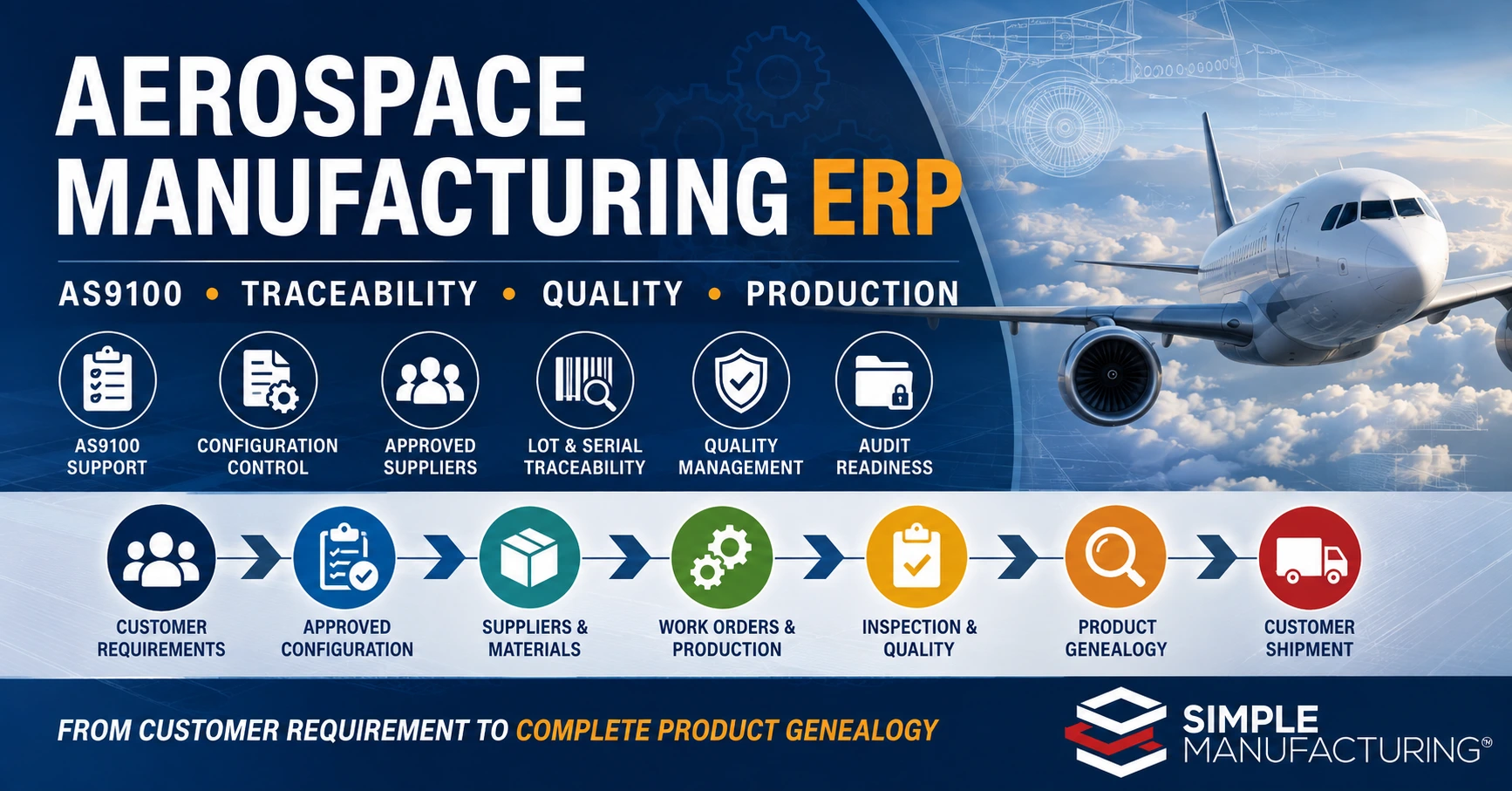
Aerospace manufacturing ERP connects customer requirements, suppliers, materials, production, quality, product genealogy, audit records, and financial transactions.
What Is Aerospace Manufacturing ERP Software?
Aerospace manufacturing ERP software is an integrated business system designed to manage the operational, quality, traceability, and financial requirements associated with producing aerospace and defense products.
The software may support:
- Customer and contract review
- Item Master and product configuration
- Revision-controlled Bills of Materials
- Approved manufacturer and supplier control
- Material Requirements Planning
- Purchase Order management
- Receiving and receiving inspection
- Lot, heat, batch, and serial-number traceability
- Work Order management
- Manufacturing routings
- Production scheduling
- Shop floor tracking
- Inspection and test management
- Nonconformance and corrective action
- Document control
- Employee training and competency
- Calibration and equipment management
- Actual manufacturing costing
- Shipping and certification records
- General Ledger integration
ERP and Quality Management Must Work Together
Aerospace production cannot be managed effectively when purchasing, inventory, Work Orders, inspection records, corrective actions, and product genealogy are maintained in unrelated systems.
Why Aerospace Manufacturers Have Specialized ERP Requirements
Aerospace manufacturers frequently operate under customer, contractual, quality, regulatory, and industry requirements that extend beyond ordinary production and accounting controls.
Complex Product Structures
Products may contain multiple assemblies, revisions, alternates, customer configurations, controlled materials, and serialized components.
Extensive Traceability
Manufacturers may need to connect suppliers, material certifications, lots, Work Orders, employees, inspections, and serialized finished products.
Supplier Risk
Purchased materials and special processes must come from approved and qualified sources.
Quality-System Integration
Inspection, nonconformance, corrective action, calibration, training, and document control must support production activity.
Customer-Specific Requirements
Each order may include unique quality clauses, certification requirements, source restrictions, and record-retention obligations.
Audit Expectations
Records must be complete, controlled, accessible, and connected with the products and transactions they support.
Core Aerospace ERP Requirements
| ERP Requirement | Business Purpose |
|---|---|
| Contract Review | Identifies customer, product, delivery, quality, documentation, and certification requirements before acceptance. |
| Configuration Management | Controls product definitions, revisions, BOMs, drawings, specifications, and effective changes. |
| Supplier Control | Restricts purchasing and processing to evaluated and approved sources. |
| Material Traceability | Preserves supplier, Purchase Order, receipt, lot, heat, batch, and certification history. |
| Work Order Control | Defines what must be produced, which revision applies, and how manufacturing will be performed. |
| Production Routing | Controls the sequence of manufacturing, inspection, testing, and outside-processing operations. |
| Quality Management | Connects inspections, nonconformance, corrective action, audits, calibration, and training. |
| Product Genealogy | Connects source materials and production history with finished-product lots or serial numbers. |
| Document Control | Ensures employees use approved and current drawings, instructions, procedures, and specifications. |
| Audit History | Records significant transactions, changes, approvals, users, and dates. |
| Actual Costing | Accumulates the actual material, labor, outside processing, machine, scrap, and overhead cost of production. |
Supporting AS9100 Quality-Management Processes
AS9100 builds upon ISO 9001 and adds aerospace-related expectations involving operational risk, configuration management, product safety, counterfeit-part prevention, supplier control, traceability, production controls, and quality-system effectiveness.
An ERP system can support these processes by connecting:
- Customer requirements and quality clauses
- Product and document revisions
- Approved suppliers and external processors
- Receiving and inspection records
- Material certifications
- Production Work Orders and routings
- Employee training and competency
- Equipment and calibration status
- Nonconformance and corrective action
- Product genealogy
- Shipping documentation
- Audit trails and retained records
ERP software does not create compliance by itself. It provides the controls, records, workflows, and visibility used to implement and demonstrate the organization’s approved quality processes.
Customer Contract and Purchase Order Review
Aerospace requirements frequently originate with the customer’s Purchase Order, contract, specifications, drawings, quality clauses, and delivery schedule.
Contract Review should evaluate:
- Customer part number
- Internal part number
- Product revision
- Ordered quantity
- Delivery schedule
- Customer drawings and specifications
- Quality clauses
- Approved source requirements
- Inspection and testing requirements
- First Article requirements
- Serialization and lot-control requirements
- Certificate of Conformance requirements
- Material-certification requirements
- Special-process requirements
- Packaging and labeling requirements
- Record-retention requirements
Flow Requirements into Operations
Requirements identified during Contract Review should be connected with Sales Orders, purchasing documents, Work Orders, inspection plans, production instructions, and shipment records.
Customer Quality Clauses and Requirement Flowdown
Customer quality clauses may define controls that must be applied throughout purchasing, production, quality, and shipping.
Order and Clauses
Review
Order Flowdown
Inspection Controls
Certification Records
The ERP system should help ensure applicable requirements are communicated to:
- Engineering
- Purchasing
- Approved suppliers
- Receiving
- Production Planning
- Shop floor employees
- Quality inspectors
- Outside processors
- Shipping personnel
Learn more in our Customer Purchase Order Quality Clauses guide.
Product Configuration and Revision Management
Configuration management helps ensure the product manufactured matches the approved customer and engineering requirements.
The controlled configuration may include:
- Internal part number
- Customer part number
- Product revision
- Bill of Materials revision
- Drawing revision
- Specification revision
- Routing revision
- Software or firmware revision
- Inspection-plan revision
- Approved alternates
- Effective dates
- Engineering Change Order
| Configuration Record | ERP Relationship |
|---|---|
| Item Master | Defines product identity, revision, classification, controls, and linked documentation. |
| Bill of Materials | Defines components, quantities, approved sources, and assembly relationships. |
| Routing | Defines manufacturing and inspection operations. |
| Work Order | Preserves the configuration authorized for a specific production build. |
| Shipment | Connects the delivered product with the manufactured configuration. |
Do Not Replace Historical Configuration Data
When revisions change, the ERP system should preserve the configuration used by previous Purchase Orders, Work Orders, inspections, and customer shipments.
Aerospace Item Master Data
The Item Master provides the controlled definition of purchased, manufactured, non-inventory, tooling, document, and service items used throughout the ERP system.
Aerospace Item Master data may include:
- Part number and revision
- Description
- Customer part numbers
- Make-or-buy classification
- Inventory stage
- Unit of measure
- Product classification
- Material specification
- Drawing and document links
- Approved manufacturers
- Approved suppliers
- Lot-control requirements
- Serial-number requirements
- Shelf-life requirements
- Inspection requirements
- Production and purchasing lead times
- Cost and financial classifications
Learn more in our Item Master Data Management guide.
Revision-Controlled Bills of Materials
The Bill of Materials defines the components, materials, subassemblies, quantities, and approved alternatives required to manufacture a product.
Aerospace BOM controls may include:
- Parent and component revisions
- Quantity per assembly
- Unit of measure
- Effective dates
- Approved manufacturer parts
- Approved suppliers
- Alternate and substitute restrictions
- Customer-specific configurations
- Reference drawings
- Material specifications
- Where-used relationships
- Engineering approval history
Engineering Definition
BOM
Requirements
Material List
Genealogy
Learn more in our Bill of Materials guide.
Approved Supplier and External Provider Control
Aerospace manufacturers depend on suppliers for raw material, components, tooling, calibration, laboratory testing, and special processes.
Supplier records may include:
- Approval status
- Approved products and services
- Customer or program restrictions
- Quality certifications
- Approval date
- Reevaluation date
- Audit history
- Performance ratings
- Delivery history
- Quality history
- Corrective-action status
- Required Purchase Order clauses
- Contact and facility information
| Supplier Status | Meaning |
|---|---|
| Approved | Authorized for the defined products, services, processes, or programs. |
| Conditional | Use is permitted subject to defined limitations or additional controls. |
| Pending | Evaluation or approval activity is incomplete. |
| Inactive | Supplier is not currently used but historical records remain available. |
| Disqualified | Purchasing is prohibited unless formally reevaluated and approved. |
Learn more in our Approved Vendor List guide.
Supplier Performance Monitoring
Supplier approval should be supported by ongoing performance monitoring.
Supplier KPIs may include:
- On-time delivery
- Receiving rejection rate
- Certificate accuracy
- Quantity accuracy
- Corrective-action responsiveness
- Audit findings
- Lead-time performance
- Purchase price performance
- Special-process performance
Quality Performance
Measure accepted, rejected, returned, and conditionally accepted receipts.
Delivery Performance
Compare confirmed supplier dates with actual receipt dates.
Documentation Performance
Track missing, incorrect, or incomplete certifications and shipping records.
Corrective-Action Performance
Monitor response time, root-cause quality, implementation, and effectiveness.
Counterfeit and Suspect-Part Prevention
Aerospace manufacturers may require controls intended to reduce the risk of counterfeit or suspect material entering the supply chain.
ERP controls can support:
- Approved manufacturer requirements
- Approved distributor and supplier restrictions
- Manufacturer part-number control
- Purchase Order quality clauses
- Certification requirements
- Lot and date-code recording
- Country-of-origin information
- Receiving inspection
- Material quarantine
- Supplier nonconformance records
- Full receipt-to-shipment traceability
Supplier Selection Must Consider More Than Price
Purchasing from an unapproved or unverifiable source can create quality, product-safety, compliance, and customer risk.
Aerospace Purchase Order Management
Supplier Purchase Orders should communicate the exact item, revision, quantity, delivery, certification, quality, and processing requirements associated with the purchase.
Purchase Order information may include:
- Internal part number
- Manufacturer part number
- Supplier part number
- Revision
- Quantity and unit of measure
- Delivery schedule
- Material specification
- Quality clauses
- Certificate requirements
- Inspection requirements
- Special-process requirements
- Customer or program reference
- Approved-source requirements
- Record-retention requirements
Learn more in our Purchase Order Management guide.
Receiving and Receiving Inspection
Receiving is the first internal control point for purchased materials and externally provided services.
Receiving may verify:
- Supplier identity
- Purchase Order and line item
- Part number and revision
- Manufacturer and manufacturer part number
- Quantity and unit of measure
- Packaging and condition
- Lot, heat, batch, date code, or serial number
- Material certifications
- Special-process certifications
- Country of origin
- Expiration or shelf-life information
- Customer and quality-clause requirements
Shipment
Certificate Review
Transaction
Acceptance
Inventory
Material requiring inspection or documentation review should remain unavailable until the required acceptance has been recorded.
Material and Process Certification Management
Material certifications, Certificates of Conformance, test reports, and special-process certifications may be required to support product acceptance and traceability.
Certification records may be linked to:
- Supplier
- Purchase Order
- Receipt
- Part number and revision
- Material specification
- Lot, heat, batch, or serial number
- Outside-processing operation
- Work Order
- Finished-product lot or serial number
- Customer shipment
The ERP system should allow rapid retrieval of the certification associated with a specific received material or delivered product.
Aerospace Inventory Management
Aerospace inventory may require detailed controls involving source, status, ownership, traceability, configuration, and cost.
Inventory records may include:
- Part number and revision
- Inventory location
- Available quantity
- Allocated quantity
- Inspection quantity
- Quality status
- Lot, heat, batch, or serial number
- Manufacturer
- Supplier
- Purchase Order and receipt
- Certificate links
- Expiration or shelf-life date
- Customer ownership
- FIFO cost layer
- Actual unit cost
| Inventory Status | Use |
|---|---|
| Available | Accepted and eligible for normal allocation and production. |
| Awaiting Inspection | Received but not yet accepted. |
| Allocated | Reserved for a customer, Work Order, or requirement. |
| Quality Hold | Temporarily unavailable pending review. |
| Rejected | Unusable without an approved disposition. |
| Customer-Owned | Restricted to the applicable customer or program. |
| Expired | Requires evaluation before use or disposition. |
Learn more in our Manufacturing Inventory Management guide.
Lot, Heat, Batch, and Serial-Number Traceability
Aerospace manufacturers may need detailed forward and backward traceability throughout purchasing, inventory, production, inspection, and shipping.
and Purchase Order
Lot or Heat
and Operations
Lot or Serial
Shipment
Traceability can help answer:
- Which supplier provided the material?
- Which Purchase Order and receipt created the inventory?
- Which certification applies?
- Which material lot or serial number was consumed?
- Which Work Order used the material?
- Which employees and machines performed the operations?
- Which inspections and tests were completed?
- Which finished products contain the material?
- Which customers received the affected products?
Learn more in our Lot and Serial Number Traceability guide.
Forward and Backward Product Genealogy
| Traceability Direction | Purpose |
|---|---|
| Backward Traceability | Starts with a finished product and identifies the materials, suppliers, employees, operations, inspections, and certifications used to manufacture it. |
| Forward Traceability | Starts with a material lot, supplier receipt, process, or defect and identifies affected Work Orders, finished products, shipments, and customers. |
Complete genealogy supports quality investigations, customer inquiries, supplier issues, recalls, containment, warranty evaluation, and audit response.
Material Requirements Planning
MRP calculates purchased and manufactured requirements using customer demand, product structures, inventory, Purchase Orders, Work Orders, and lead times.
Aerospace MRP may evaluate:
- Customer Sales Orders
- Delivery schedules
- Forecasts
- Multi-level Bills of Materials
- Available and allocated inventory
- Inventory awaiting inspection
- Open Purchase Orders
- Open Work Orders
- Approved suppliers
- Purchasing and production lead times
- Minimum order quantities
- Safety stock
- Customer-owned material
The planning system can recommend new Purchase Orders and Work Orders, as well as expediting, deferring, increasing, reducing, or cancelling existing supply.
Learn more in our MRP Software for Manufacturers guide.
Aerospace Work Order Management
The Work Order provides the central production record authorizing the manufacture, repair, rework, or processing of a product.
An aerospace Work Order may include:
- Product part number and revision
- Customer and Sales Order
- Quantity required
- Due date
- Bill of Materials
- Material allocations and issues
- Manufacturing routing
- Outside-processing operations
- Drawings and work instructions
- Inspection and testing requirements
- Customer quality clauses
- Employee labor
- Machine and equipment records
- Lot and serial-number requirements
- Completed, rejected, and scrapped quantities
- Actual manufacturing cost
The Work Order should preserve the approved product configuration and the complete as-built manufacturing history.
Learn more in our Manufacturing Work Order Management guide.
Manufacturing Routing and Operation Control
Manufacturing routings define the sequence of production, inspection, testing, and outside-processing operations required to manufacture the product.
Routing records may define:
- Operation number
- Operation description
- Work center
- Required employee qualification
- Required equipment
- Setup and production time
- Inspection requirements
- Work instructions
- Special-process supplier
- Required documentation
- Completion and acceptance criteria
Preparation
Operations
Inspection
Processing
and Acceptance
Learn more in our Manufacturing Routing Software guide.
Outside Processing and Special Processes
Aerospace production may require processes performed by external suppliers.
Examples include:
- Heat treatment
- Plating
- Anodizing
- Painting and coating
- Welding
- Nondestructive testing
- Laboratory testing
- Calibration
- Specialized machining
Outside-processing control may include:
- Approved processor
- Purchase Order
- Applicable specification and revision
- Work Order and routing operation
- Quantity sent
- Lot or serial numbers sent
- Date shipped and expected return date
- Certification requirements
- Quantity received
- Receiving inspection
- Actual processing cost
Maintain Traceability While Product Is Outside the Facility
The ERP system should preserve ownership, quantity, status, lot or serial identity, supplier, documentation, and routing information throughout outside processing.
Aerospace Production Scheduling
Production scheduling coordinates Work Orders, routing operations, employees, machines, materials, inspection resources, outside processors, and customer dates.
Scheduling may consider:
- Customer priority
- Contract delivery date
- Material availability
- Operation sequence
- Work-center capacity
- Qualified employees
- Machine availability
- Tooling and fixture availability
- Inspection capacity
- Outside-processing lead time
- Planned maintenance
- Production risk
Learn more in our Manufacturing Production Scheduling guide.
Shop Floor Tracking and Production Visibility
Shop floor tracking records manufacturing activity as work is performed.
Employees and supervisors may record or review:
- Released Work Orders
- Current operation
- Setup and production labor
- Employees performing work
- Machines and equipment used
- Completed quantities
- Rejected and scrap quantities
- Downtime
- Inspection requirements
- Material usage
- Production holds
- Operation completion
Current Production Status Supports Better Decisions
Real-time Work Order information helps Production Planning, Quality, Shipping, and management identify delays, shortages, bottlenecks, and delivery risks.
Learn more in our Shop Floor Tracking Software guide.
Employee Training and Competency
Employees performing aerospace manufacturing, inspection, testing, special processes, and quality-system activities may require defined qualifications and documented competency.
Training-management controls may include:
- Training requirements by job title
- Training requirements by work center
- Product- and customer-specific training
- Equipment qualifications
- Inspection qualifications
- Document-revision training
- Competency levels
- Certification expiration
- Automatic notifications
- Training evidence and test results
- Workforce gap analysis
The system can help prevent an employee from beginning a controlled operation when required training or competency has expired.
Learn more in our Employee Training Management guide.
Equipment, Tooling, and Calibration Management
Manufacturing and inspection depend on machines, tools, fixtures, gauges, and measuring equipment that must be available and suitable for use.
Equipment records may include:
- Equipment ID
- Description and type
- Department or location
- Calibration requirements
- Calibration due date
- Calibration results
- Maintenance schedule
- Current status
- Repair history
- Certificates and reports
- Associated Work Orders or inspections
Do Not Assign Unavailable Equipment
Production and inspection systems should identify equipment that is out of calibration, under maintenance, damaged, or otherwise unavailable.
Inspection and Test Management
Inspection and test requirements should be connected with receiving, Work Orders, routing operations, product characteristics, and customer requirements.
Inspection types may include:
- Receiving inspection
- First-piece inspection
- First Article Inspection
- In-process inspection
- Final inspection
- Functional testing
- Nondestructive testing
- Source inspection
- Customer inspection
- Certificate review
| Inspection Information | Purpose |
|---|---|
| Requirement | Defines the characteristic, specification, or acceptance criteria. |
| Actual Result | Records the observed or measured value. |
| Equipment Used | Identifies the measuring or test equipment. |
| Inspector | Identifies the person performing the inspection. |
| Lot or Serial Number | Connects results with the inspected product. |
| Disposition | Records acceptance, rejection, rework, or authorized disposition. |
Nonconforming Material Control
Nonconformance records identify products, materials, processes, or documents that do not meet applicable requirements.
A nonconformance record may include:
- Part number and revision
- Work Order or Purchase Order
- Operation
- Quantity affected
- Lot or serial number
- Requirement
- Actual condition
- Defect category
- Immediate containment
- Disposition
- Approvals
- Rework instructions
- Reinspection results
- Supplier relationship
- Corrective-action relationship
Material placed on quality hold should remain unavailable for production or shipment until an authorized disposition is completed.
Corrective Action Management
Corrective action provides a controlled method for investigating significant or recurring problems, implementing actions, and evaluating effectiveness.
Nonconformance
Analysis
Action
Verification
Corrective-action records may include:
- Problem statement
- Affected products and customers
- Containment activity
- Root-cause analysis
- Assigned actions
- Responsible employees
- Due dates
- Supporting documents
- Implementation evidence
- Effectiveness review
- Closure approval
Learn more in our Corrective Action Management guide.
Supplier Corrective Action
Supplier corrective actions connect purchased-product issues with the responsible external provider.
The record may connect:
- Supplier
- Purchase Order
- Receipt
- Rejected quantity
- Material lot or serial number
- Inspection results
- Containment requirement
- Supplier response
- Root cause
- Corrective action
- Effectiveness verification
- Supplier-performance rating
This integration allows supplier problems to affect reevaluation and future sourcing decisions.
Document Control and Revision Management
Aerospace manufacturers must control the documents used to define, manufacture, inspect, and accept products.
Controlled documents may include:
- Quality manuals
- Policies and procedures
- Engineering drawings
- Manufacturing work instructions
- Inspection plans
- Specifications
- Forms
- CNC programs
- Customer documents
- Supplier documents
- Packaging instructions
Document-control software should support:
- Unique document identification
- Revision history
- Approval workflows
- Effective dates
- Distribution and access control
- Obsolete-document protection
- Training requirements
- Linked records
- Electronic audit history
Learn more in our Document Control Software guide.
Operational Risk Management
Aerospace manufacturing risks may affect product conformity, delivery performance, product safety, customer satisfaction, and business continuity.
Operational risks may include:
- Single-source material
- Long-lead components
- Supplier performance
- Material shortages
- Equipment failure
- Insufficient qualified employees
- Outside-processing delays
- Configuration errors
- Inspection capacity
- Quality escapes
- Counterfeit-part exposure
- Obsolete components
| Risk Information | Purpose |
|---|---|
| Risk Description | Explains the condition or potential failure. |
| Potential Impact | Identifies possible product, schedule, customer, financial, or compliance consequences. |
| Probability and Severity | Supports consistent risk evaluation. |
| Mitigation | Defines actions intended to reduce exposure. |
| Responsible Owner | Assigns accountability. |
| Review Date | Ensures ongoing monitoring. |
Product Safety and Critical Requirements
Some aerospace products and processes may include safety-related characteristics or requirements that require additional control.
ERP and quality records may identify:
- Critical items
- Key characteristics
- Special inspection requirements
- Qualified personnel
- Controlled suppliers
- Special-process certifications
- Additional approvals
- Escalation requirements
- Traceability and record-retention requirements
These requirements should remain visible throughout planning, purchasing, production, inspection, and shipment.
Actual Aerospace Work Order Costing
Integrated manufacturing costing accumulates the actual expenses associated with each Work Order.
| Cost Component | Transaction Source |
|---|---|
| Direct Material | Actual FIFO inventory layers consumed during production |
| Direct Labor | Employee setup, production, inspection, and rework time |
| Machine Cost | Equipment usage and applicable machine rates |
| Outside Processing | Supplier Purchase Orders and received processing services |
| Inspection and Testing | Internal labor, equipment time, and outside laboratory services |
| Scrap and Rework | Additional material, labor, processing, and inspection |
| Manufacturing Overhead | Burden allocated according to company policy |
Actual cost history supports quoting, profitability analysis, inventory valuation, Cost of Goods Sold, and continuous improvement.
Learn more in our Actual Work Order Costing guide.
Shipping, Certification, and Delivery Records
Before shipment, the ERP system can verify that required production, inspection, certification, documentation, and approval activities are complete.
Shipment documentation may include:
- Packing list
- Certificate of Conformance
- Material certifications
- Special-process certifications
- Inspection and test reports
- First Article documentation
- Lot and serial-number lists
- Customer labels
- Export or shipping documentation
- Customer-specific forms
Do Not Release Incomplete Product
Shipment controls should prevent delivery when required inspections, certifications, nonconformance dispositions, customer approvals, or documentation are incomplete.
Audit Readiness and Compliance Visibility
Aerospace manufacturers may undergo internal audits, certification audits, customer audits, supplier audits, regulatory reviews, and quality investigations.
Auditors may request evidence involving:
- Contract Review
- Customer requirements
- Approved suppliers
- Supplier evaluations
- Purchase Orders and flowdown
- Receiving and inspection
- Material certifications
- Traceability and genealogy
- Work Orders and production records
- Employee qualifications
- Calibration records
- Nonconformance and corrective action
- Document revisions
- Internal audits
- Management Review
Audit readiness improves when evidence is created during normal operations and retained with the transactions, products, employees, suppliers, and customers it supports.
Electronic Audit Trails
Electronic audit history can identify who performed a significant action and when it occurred.
Audit trails may record:
- Record creation
- Original and revised values
- User making the change
- Date and time
- Approval
- Status changes
- Revision changes
- Inventory transactions
- Inspection decisions
- Nonconformance dispositions
- Work Order completion
- Shipment release
Historical transactions should remain available even when the current business record changes.
Management Review and Quality Metrics
Integrated ERP and quality data can provide management with current information regarding operational and quality-system performance.
Management Review information may include:
- Customer delivery performance
- Customer complaints
- Internal and external audit results
- Supplier quality and delivery
- Nonconformance trends
- Corrective-action status
- Training and competency gaps
- Calibration status
- Production performance
- Scrap and rework
- Material shortages
- Operational risks
- Improvement opportunities
Aerospace Manufacturing ERP KPIs
| KPI | What It Measures |
|---|---|
| On-Time Delivery | Customer shipments completed by the committed date. |
| Supplier On-Time Delivery | Supplier receipts completed by confirmed dates. |
| Supplier Defect Rate | Rejected supplier quantity compared with total receipts. |
| Inventory Accuracy | Recorded inventory compared with verified physical inventory. |
| Material Shortage Rate | Work Orders delayed by unavailable material. |
| First-Pass Yield | Products accepted without rework. |
| Scrap Rate | Quantity or value permanently lost during production. |
| Rework Rate | Quantity requiring additional controlled processing. |
| Corrective-Action Closure | Corrective actions completed within defined due dates. |
| Training Compliance | Required employee qualifications that remain current. |
| Calibration Compliance | Required equipment remaining within calibration. |
| Audit Finding Closure | Audit findings completed by agreed dates. |
| Actual Cost Variance | Estimated or quoted cost compared with actual Work Order cost. |
Why Generic ERP and Accounting Systems May Fall Short
Many business systems focus primarily on accounting, purchasing, sales, and basic inventory. Aerospace manufacturers may then rely on spreadsheets and standalone databases for quality and traceability.
| Missing Capability | Common Workaround | Potential Risk |
|---|---|---|
| Detailed Product Genealogy | Spreadsheets and paper travelers | Incomplete or slow traceability investigations |
| Supplier Qualification | Separate Approved Vendor List | Purchasing from an unapproved source |
| Quality Management | Standalone QMS database | Quality records disconnected from orders and products |
| Document Control | Shared folders and manual revision lists | Use of obsolete instructions |
| Training Control | Human Resources spreadsheets | Expired qualifications and incomplete evidence |
| Corrective Action | Documents and email | Missed due dates and weak effectiveness verification |
| Actual Costing | Manual spreadsheets | Incomplete product-cost and profitability information |
Disconnected Systems Create Multiple Sources of Truth
Engineering, Purchasing, Inventory, Production, Quality, and Accounting may make decisions using different revisions, quantities, statuses, and dates.
Aerospace ERP Software Selection Checklist
| Evaluation Area | Questions to Ask |
|---|---|
| Contract Review | Can customer, product, quality, delivery, certification, and documentation requirements be captured and flowed down? |
| Configuration Management | Can revisions, BOMs, drawings, routings, documents, and effective changes be controlled? |
| Supplier Management | Can purchasing be limited to approved providers and approved products or processes? |
| Traceability | Can the system trace materials from supplier receipt through Work Orders and customer shipment? |
| Inventory | Can it manage lots, heats, serials, status, ownership, certifications, locations, and costs? |
| Work Orders | Can it preserve configuration, materials, routings, employees, equipment, inspections, and genealogy? |
| Quality Management | Can it manage inspections, nonconformance, corrective action, audits, training, and calibration? |
| Document Control | Can employees access current approved documents while obsolete revisions remain protected? |
| Audit History | Can significant changes, approvals, users, dates, and transactions be retrieved? |
| Costing | Can actual materials, labor, processing, scrap, rework, and overhead be calculated? |
| Reporting | Can management retrieve current operational, quality, traceability, and financial information? |
| Integration | Are purchasing, production, quality, shipping, and accounting connected in one system? |
Aerospace Manufacturing ERP with SimpleManufacturing™
SimpleManufacturing™ connects customer requirements, Item Master data, Bills of Materials, MRP, suppliers, purchasing, receiving, inventory, Work Orders, routings, production scheduling, shop floor tracking, quality management, product genealogy, shipping, costing, and accounting.
| SimpleManufacturing™ Capability | Business Benefit |
|---|---|
| Contract Review | Records customer, product, delivery, quality, certification, and documentation requirements. |
| Item and Configuration Control | Maintains part numbers, revisions, classifications, documents, and customer relationships. |
| Bill of Materials | Controls multi-level product structures, components, revisions, and approved alternatives. |
| MRP | Calculates purchased and manufactured requirements using current demand and supply. |
| Approved Supplier Management | Controls qualified suppliers, products, processes, certifications, and performance. |
| Purchase Order Flowdown | Communicates item, revision, certification, quality-clause, and delivery requirements. |
| Receiving and Inspection | Records material identity, certifications, lots, serials, inspection results, and acceptance. |
| Inventory Management | Controls quantities, locations, status, ownership, FIFO cost, lots, and serial numbers. |
| Work Order Management | Connects materials, routings, employees, equipment, quality, genealogy, and completion. |
| Production Scheduling | Coordinates customer priorities, Work Orders, materials, resources, and due dates. |
| Shop Floor Tracking | Provides current labor, quantities, operations, holds, and production status. |
| Quality Management | Connects inspections, nonconformance, corrective action, audits, training, and calibration. |
| Document Control | Provides approved revisions and complete document history. |
| Product Genealogy | Connects suppliers and material receipts with finished products and customer shipments. |
| Actual Work Order Costing | Accumulates materials, labor, outside processing, machine, rework, and overhead cost. |
| Accounting Integration | Connects inventory, WIP, Finished Goods, COGS, revenue, receivables, and payables. |
One Connected Record from Customer Requirement Through Shipment
SimpleManufacturing™ provides one database connecting customer requirements, approved product configurations, purchased materials, production history, quality records, certifications, genealogy, cost, and delivered products.
Frequently Asked Questions About Aerospace Manufacturing ERP
What is aerospace manufacturing ERP software?
Aerospace manufacturing ERP integrates customer requirements, product configuration, suppliers, purchasing, inventory, MRP, Work Orders, production, quality, traceability, costing, shipping, and accounting.
What ERP capabilities do aerospace manufacturers require?
Common requirements include Contract Review, configuration control, supplier management, lot and serial traceability, Work Orders, production routings, quality management, document control, training, calibration, audit history, and actual costing.
Can ERP software support AS9100 processes?
Yes. ERP software can support approved organizational processes by maintaining controlled records, workflows, approvals, traceability, supplier controls, training records, inspections, corrective actions, and audit evidence.
Does ERP software make a company AS9100 compliant?
No. Compliance depends on the organization’s quality-management system, procedures, implementation, employee competency, leadership, and retained evidence. ERP software supports those processes.
Why is traceability important in aerospace manufacturing?
Traceability connects source materials, suppliers, certifications, Work Orders, operations, inspections, finished products, and customer shipments for investigations, containment, recalls, audits, and customer inquiries.
What is product genealogy?
Product genealogy is the complete manufacturing history connecting the materials, suppliers, employees, operations, equipment, inspections, and documentation associated with a finished product.
What is forward traceability?
Forward traceability identifies the Work Orders, finished products, shipments, and customers affected by a material lot, receipt, supplier, process, or quality issue.
What is backward traceability?
Backward traceability begins with a delivered or finished product and identifies the materials, suppliers, production records, inspections, and certifications used to create it.
How are aerospace suppliers controlled?
Suppliers can be evaluated, approved for defined products or services, monitored through performance metrics, audited, reevaluated, and restricted from purchasing when no longer approved.
How are customer quality clauses managed?
Quality clauses are identified during Contract Review and flowed into purchasing, Work Orders, inspection plans, production instructions, shipping, and certification records.
How are material certifications managed?
Certifications can be attached to supplier receipts and linked with lots, heats, serial numbers, Work Orders, finished products, and customer shipments.
What is configuration management?
Configuration management controls product identity, revisions, BOMs, drawings, specifications, routings, software, changes, and the configuration used for each production build.
How are outside special processes controlled?
Outside processes can be linked with approved suppliers, Purchase Orders, routing operations, specifications, quantities, serial numbers, certifications, receipts, inspections, and Work Order cost.
How does an ERP system control employee qualifications?
Training requirements and competency records can be connected with job titles, work centers, equipment, products, and routing operations to verify qualification before work begins.
How does ERP support calibration management?
ERP can maintain equipment identity, calibration frequency, due dates, results, certificates, status, and relationships with inspections or production operations.
How are nonconforming products controlled?
Nonconformance records identify the affected product, quantity, requirement, actual condition, lot or serial number, containment, disposition, approvals, rework, and reinspection.
What is corrective action management?
Corrective action manages containment, root-cause analysis, assigned actions, implementation evidence, effectiveness verification, and closure.
Why do generic ERP systems fall short for aerospace manufacturers?
Systems designed mainly for accounting and basic inventory may lack configuration control, detailed genealogy, quality management, supplier qualification, document control, and connected audit records.
What should aerospace manufacturers consider when selecting ERP software?
They should evaluate configuration management, customer-requirement flowdown, supplier control, traceability, production, quality, document control, training, calibration, audit history, costing, reporting, and integration.
How does SimpleManufacturing™ support aerospace manufacturing?
SimpleManufacturing™ connects Contract Review, Item Master data, BOMs, MRP, suppliers, purchasing, inventory, Work Orders, routings, scheduling, shop floor tracking, quality, document control, genealogy, costing, shipping, and accounting.
Connect Aerospace Production, Quality, and Traceability
Aerospace manufacturing ERP must support the complete product lifecycle from customer requirements and approved product configuration through purchasing, production, quality acceptance, product genealogy, shipment, and financial reporting.
When operational and quality information is integrated, manufacturers can improve requirement flowdown, supplier control, material visibility, production status, traceability, audit readiness, and management decision-making.
One Source of Truth for Aerospace Manufacturing
Integrated aerospace ERP provides Engineering, Supply Chain, Production, Quality, Shipping, Accounting, and management with a shared record of the product, its requirements, its manufacturing history, and its current status.
SimpleManufacturing™ provides aerospace manufacturing ERP for small and mid-sized manufacturers requiring AS9100 process support, product configuration, approved suppliers, MRP, Work Orders, production scheduling, quality management, document control, genealogy, actual costing, and integrated accounting.