
Manufacturing Labor Management Software
SimpleManufacturing™ Labor Management Software helps small and mid-sized manufacturers capture employee time, connect labor with Work Orders and routing operations, measure production performance, and calculate actual manufacturing labor cost within one integrated ERP system.
Manufacturing labor is more than attendance. Manufacturers need to know which employee performed the work, which job and operation received the time, how actual hours compare with planned hours, what quantity was completed, and how labor affected the final cost of the product.
SimpleManufacturing™ connects labor collection with employees, departments, work centers, Work Orders, manufacturing routings, production quantities, shop floor activity, quality records, actual costing, payroll preparation, and management reporting.
Turn Employee Time into Manufacturing Information
Labor recorded at the point of work gives Production, Scheduling, Cost Accounting, and management a current view of job progress, employee activity, labor efficiency, and actual manufacturing cost.

SimpleManufacturing™ connects employee labor with manufacturing jobs, routing operations, work centers, production quantities, and actual Work Order cost.
What Is Manufacturing Labor Management Software?
Manufacturing labor management software records, organizes, and reports the employee time and production activity required to complete manufacturing work. Unlike a basic time clock that records only when an employee arrives and leaves, manufacturing labor tracking assigns productive time to the specific Work Order, routing operation, work center, department, or indirect activity being performed.
A complete labor transaction may identify:
- Employee and department
- Work Order and manufactured item
- Routing operation and work center
- Setup, production, inspection, rework, or indirect activity
- Start time, stop time, and total hours
- Quantity completed, accepted, rejected, or scrapped
- Employee labor rate or applicable costing rate
- Actual labor cost assigned to the job
- Comments, exceptions, or production status
Accurate labor collection connects the time employees spend with the products, jobs, operations, quantities, and costs created by that work.
Why Manufacturing Labor Tracking Matters
Labor affects production capacity, schedules, delivery performance, Work Order cost, employee utilization, quotation accuracy, and product profitability. When time is collected on paper or entered into disconnected spreadsheets, supervisors may not know the current status of a job until hours or days after the work occurred.
Current Job Visibility
See which jobs and routing operations employees are performing and how much production has been completed.
Actual Labor Cost
Assign recorded employee time and applicable rates directly to the Work Order that consumed the labor.
Labor Efficiency
Compare planned setup and run hours with actual time to identify estimating, routing, training, or production issues.
Better Scheduling
Use current operation progress and historical labor performance to improve future schedules and capacity plans.
Improved Accountability
Maintain an electronic history of who performed the work, when it occurred, and which job received the time.
Stronger Quoting
Use actual labor history from completed jobs to improve estimates for repeat and similar manufacturing work.
How Manufacturing Labor Collection Works
Released
Job and Operation
Recorded
Cost Updated
Reported
Employees can record labor as work is performed. Each transaction updates the manufacturing record and can provide supervisors with current job status without waiting for paper travelers or end-of-shift spreadsheets to be collected and reentered.
| Labor Event | Manufacturing Result |
|---|---|
| Employee Starts Setup | Connects the employee with the Work Order, operation, work center, and setup start time. |
| Production Begins | Identifies active production labor and updates the operation’s current status. |
| Quantity Reported | Updates completed, accepted, rejected, rework, scrap, and remaining quantities. |
| Employee Stops Work | Calculates elapsed labor time and records the transaction against the job. |
| Operation Completed | Updates routing progress and makes the next eligible operation visible. |
| Work Order Completed | Includes actual labor in the completed product’s manufacturing cost and history. |
Track Labor by Manufacturing Activity
Not every employee hour has the same operational or financial meaning. Classifying labor consistently helps manufacturers understand where time is being used and which activities should be assigned directly to production.
| Labor Category | Example Activity | Management Use |
|---|---|---|
| Setup Labor | Preparing machines, programs, tooling, fixtures, and material. | Measures changeover performance and setup standards. |
| Direct Production Labor | Machining, assembly, fabrication, processing, or testing. | Calculates actual job labor and production efficiency. |
| Inspection Labor | First-piece, in-process, receiving, or final inspection. | Measures quality effort and inspection workload. |
| Rework Labor | Controlled correction of nonconforming product. | Identifies the labor cost of quality problems. |
| Indirect Labor | Training, meetings, maintenance, cleanup, and administration. | Separates non-job activity from direct manufacturing labor. |
Work Order Labor Tracking
The Work Order provides the structure required to connect labor with a specific manufacturing demand. Employees record time against the applicable job and routing step instead of entering hours into a disconnected time sheet with no production context.
Work Order labor visibility may include:
- Employees currently working on the job
- Planned and actual setup hours
- Planned and actual production hours
- Labor hours by routing operation
- Completed and remaining quantities
- Accepted, rejected, scrapped, and rework quantities
- Current operation and production status
- Actual labor cost by employee or operation
- Estimated-to-actual performance
- Complete labor transaction history
Learn more about the complete production record in our Manufacturing Work Order Management Software guide.
Routing and Work Center Labor Management
Manufacturing routings divide production into controlled operations. Recording labor by routing step helps manufacturers determine where time was spent, which work centers are overloaded, and whether production standards reflect actual performance.
Operation-Level Time
Separate setup, run, inspection, rework, and other time for each routing operation.
Work Center Activity
Review labor assigned to machining, assembly, inspection, shipping, or other operational areas.
Employee Assignment
Identify who performed each operation and preserve the production labor history.
Standard vs. Actual
Compare routing estimates with recorded time to improve planning and future standards.
Actual Manufacturing Labor Costing
Actual labor costing assigns recorded employee time and the applicable labor rate to the Work Order or routing operation that received the work. This allows the completed product to include the labor actually consumed during production rather than relying only on an estimate.
| Costing Element | Purpose |
|---|---|
| Employee Time | Records the actual hours spent on the manufacturing activity. |
| Labor Rate | Applies the appropriate employee, classification, work center, or operation rate. |
| Routing Operation | Identifies where the labor occurred within the manufacturing process. |
| Work Order | Accumulates labor with materials, outside processing, machine time, and overhead. |
| Completed Quantity | Supports calculation of actual labor hours and labor cost per completed unit. |
Actual Labor Improves Product and Customer Profitability Analysis
When labor remains connected with the job that consumed it, manufacturers can compare estimates with actual results, identify unprofitable work, and improve future quotations.
See how labor combines with materials and other production costs in our Actual Work Order Costing guide.
Labor Efficiency and Production Reporting
Labor reporting should help management understand production performance without reducing employee activity to a single isolated number. Planned time, actual time, quantity, quality, routing complexity, downtime, and material availability all affect labor results.
| Labor Metric | Business Use |
|---|---|
| Estimated vs. Actual Setup Hours | Identifies opportunities to improve setup methods and routing standards. |
| Estimated vs. Actual Run Hours | Measures production performance and the accuracy of planned operation time. |
| Labor Hours per Unit | Compares production effort across jobs, products, or reporting periods. |
| Rework Labor | Measures the employee time required to correct nonconforming work. |
| Indirect Labor | Identifies employee time not assigned directly to manufacturing jobs. |
| Labor Utilization | Compares available labor time with direct and indirect activity. |
Investigate the Context Behind the Number
A labor variance may be caused by inaccurate standards, material shortages, equipment downtime, engineering changes, training needs, rework, inspection holds, or production problems. Labor reports should support investigation, not assumptions.
Manufacturing Labor Entry Screens
SimpleManufacturing™ provides production labor-entry screens that connect employee time and reported quantities with Work Orders and routing activity.
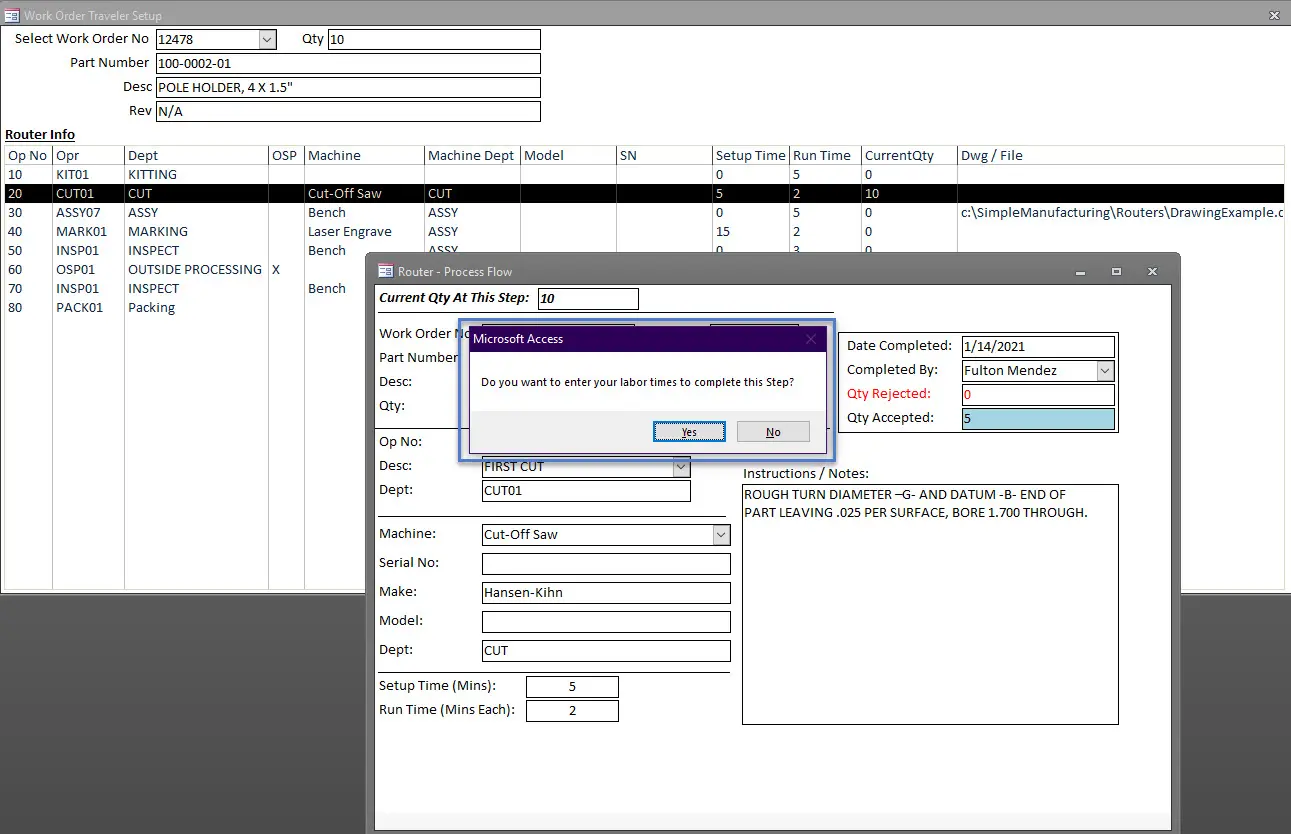
Work Order Labor Collection
Record employee labor, routing activity, production quantities, and job progress against the applicable manufacturing Work Order.
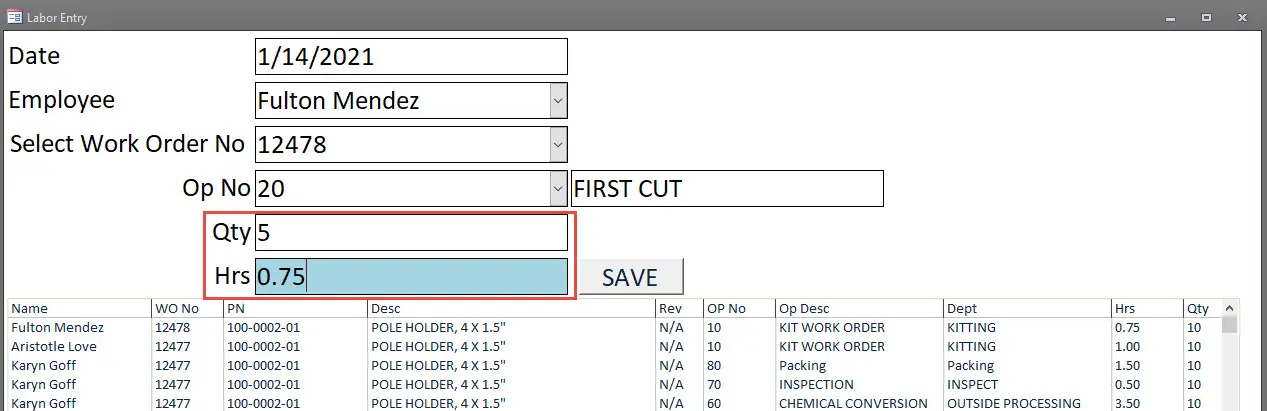
Shop Floor Labor Visibility
Review employee time, production activity, operation progress, completed quantities, and manufacturing labor performance.
Labor Management Integrated with Manufacturing ERP
Labor data becomes more useful when it is connected with the rest of the manufacturing system. SimpleManufacturing™ integrates employee activity with the transactions, items, operations, quantities, and costs that define production.
Work Order Management
Connect labor with the job, product, quantity, due date, materials, operations, status, and actual cost.
Shop Floor Tracking
Combine labor with production quantities, operation progress, downtime, holds, and real-time manufacturing status.
Bill of Materials
Connect product materials with routing operations and the labor required to manufacture the assembly.
Employee Time Clock
Maintain employee attendance and time information used for workforce visibility and payroll preparation.
Inventory Control
Connect production labor with the material issued, returned, scrapped, and completed through the Work Order.
Manufacturing Traceability
Preserve employee and operation history with material lots, serial numbers, Work Orders, and finished products.
Manufacturing Labor Management Features
Employee Labor Entry
Capture time by employee, job, operation, work center, and activity.
Work Order Labor
Assign actual employee hours and labor cost to manufacturing jobs.
Routing Labor
Record setup and production time by controlled manufacturing operation.
Production Quantities
Record completed, accepted, rejected, rework, and scrap quantities.
Labor Costing
Calculate actual labor cost using recorded time and applicable rates.
Efficiency Reporting
Compare estimated and actual time, quantity, and production performance.
Indirect Labor
Classify training, meetings, maintenance, cleanup, and non-job activity.
Electronic History
Preserve employee, Work Order, operation, transaction, and date records.
Management Reporting
Review labor by employee, job, department, operation, and reporting period.
Industries Using Manufacturing Labor Management Software
Aerospace Manufacturing
Connect employee activity with controlled operations, Work Orders, quality records, and traceable production history.
Electronics Manufacturing
Track labor across assembly, inspection, testing, rework, and production completion.
Medical Device Manufacturing
Maintain employee and operation history within controlled manufacturing and quality processes.
CNC Machine Shops
Compare setup and run standards with actual labor by machine, operation, and job.
Contract Manufacturing
Measure labor and profitability across customer-specific jobs, products, and routing requirements.
Industrial Equipment
Track labor across fabrication, machining, assembly, testing, installation, and rework.
Frequently Asked Questions About Manufacturing Labor Management
What is manufacturing labor management software?
Manufacturing labor management software records employee time and production activity by Work Order, routing operation, work center, department, or indirect activity. It supports job visibility, labor efficiency, actual costing, scheduling, and reporting.
What is the difference between attendance time and manufacturing labor?
Attendance time records when an employee is present. Manufacturing labor assigns employee time to the specific job, operation, work center, or indirect activity that consumed the time.
How does labor tracking integrate with Work Orders?
Employees record time against the applicable Work Order and routing operation. The labor transaction updates job progress, operation history, estimated-to-actual performance, and actual Work Order cost.
Can manufacturing labor software track setup and production separately?
Yes. Setup, production, inspection, rework, and indirect labor can be recorded separately so manufacturers can understand how employee time is used.
How is actual manufacturing labor cost calculated?
Actual labor cost is calculated using the recorded employee time and the applicable employee, labor-classification, work-center, or operation rate. The resulting cost is assigned to the Work Order.
What labor-efficiency information can manufacturers review?
Manufacturers can compare planned and actual setup hours, run hours, labor hours per unit, completed quantities, rework labor, indirect time, and labor utilization.
Does labor tracking support manufacturing traceability?
Yes. Employee and operation history can remain connected with the Work Order, materials, lots, serial numbers, production quantities, quality activity, and finished product.
How does SimpleManufacturing™ manage production labor?
SimpleManufacturing™ connects employee labor with Work Orders, routing operations, work centers, quantities, shop floor status, actual costing, time-clock information, traceability, and manufacturing reporting.
Improve Labor Visibility from the Shop Floor to Actual Cost
Accurate manufacturing labor information helps supervisors understand current production, helps planners improve schedules, helps estimators refine future quotations, and helps accounting calculate the real cost of completed work.
One Labor Record Connected with the Complete Manufacturing Job
SimpleManufacturing™ connects employees, Work Orders, routing operations, work centers, production quantities, quality activity, actual cost, and manufacturing history within one integrated ERP system.
SimpleManufacturing™ Labor Management Software is designed for small and mid-sized manufacturers that need practical labor collection, production visibility, and actual job costing without disconnected spreadsheets or duplicate data entry.
Request a Labor Management Software Demonstration
Call SimpleManufacturing™ at 858-335-6421.