
AS9100 Management Review Metrics and Strategies
AS9100 management review gives leadership a structured process for evaluating quality-system performance, operational results, customer satisfaction, supplier performance, risks, resources, and continuous-improvement priorities.
Management review is sometimes treated as a periodic compliance meeting created only to satisfy an auditor. A well-designed review process is much more valuable. It gives leadership current information about whether the organization is meeting customer commitments, controlling manufacturing risks, improving quality, maintaining qualified resources, and achieving its business objectives.
Manufacturers gain the greatest value when management-review information is generated from connected ERP and quality-management records rather than manually assembled from spreadsheets, emails, paper documents, and separate databases.
Management review should help leadership understand what is working, what is deteriorating, where risk is increasing, which actions are overdue, and where additional resources or improvement efforts are required.
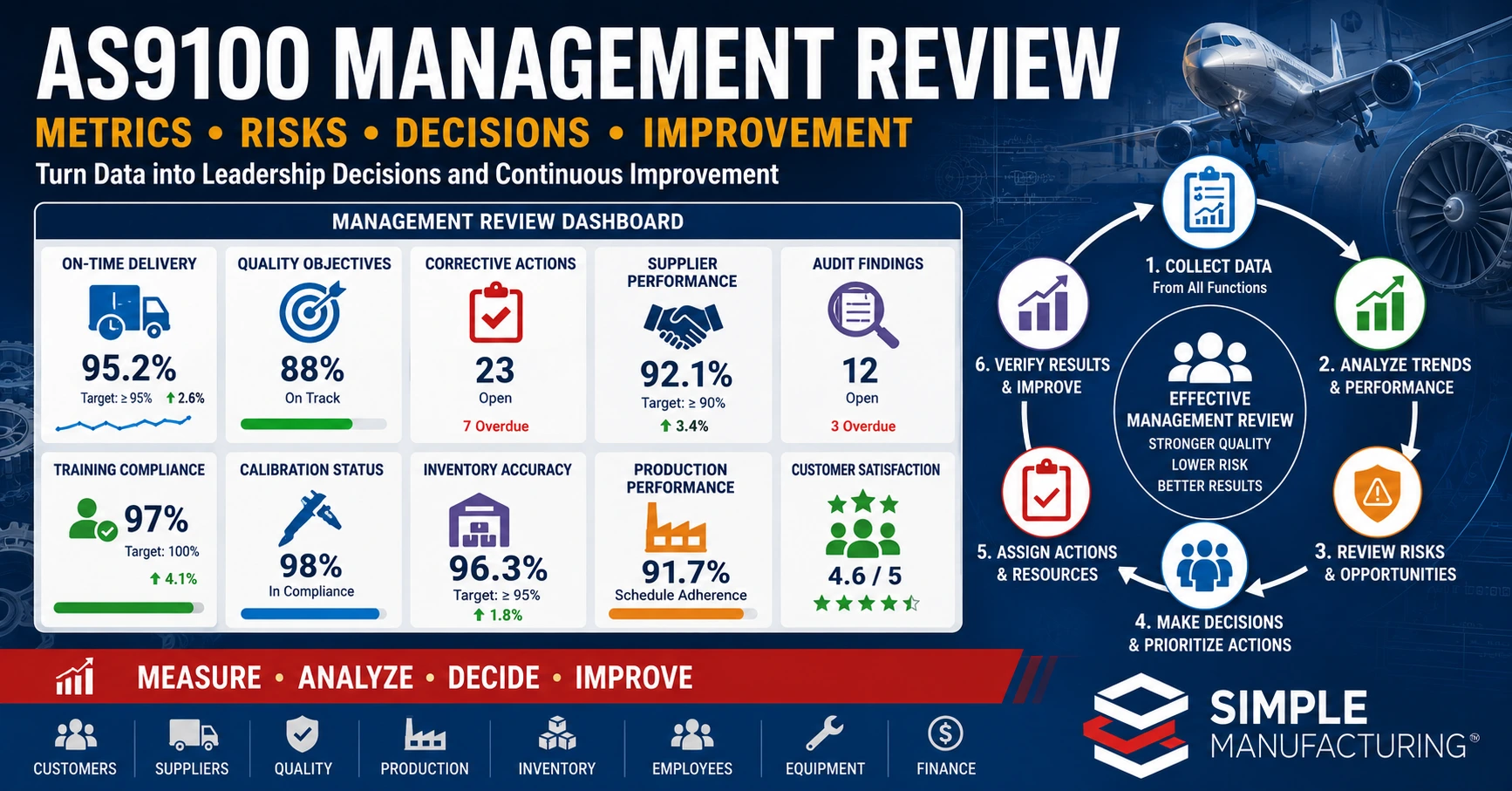
AS9100 management review connects quality objectives, customer performance, corrective actions, suppliers, audits, training, calibration, production, resources, and operational risk.
What Is AS9100 Management Review?
Management review is a formal leadership process used to evaluate the continuing suitability, adequacy, effectiveness, and alignment of the quality-management system with the organization’s strategic direction.
The review process normally evaluates information from multiple departments and business processes, including:
- Sales and customer service
- Engineering
- Purchasing and supplier management
- Receiving and inventory
- Production planning
- Manufacturing operations
- Quality assurance
- Employee training
- Equipment and calibration management
- Shipping and customer delivery
- Corrective action and continuous improvement
- Financial and resource planning
Evaluate Performance
Review whether processes, objectives, products, suppliers, and customer commitments are performing as intended.
Identify Risk
Recognize developing operational, quality, supplier, resource, product-safety, and delivery risks.
Assign Action
Define decisions, responsibilities, resources, due dates, and follow-up activities.
Drive Improvement
Use trends and evidence to improve processes rather than repeatedly reacting to individual problems.
Why Management Review Matters
Management review keeps the quality-management system connected with business operations and leadership priorities.
Without active management involvement, quality systems can become isolated from production and treated as the responsibility of the Quality department alone.
An effective review helps leadership:
- Monitor customer satisfaction and delivery performance
- Evaluate whether quality objectives are being achieved
- Identify recurring defects and process weaknesses
- Monitor corrective-action effectiveness
- Evaluate supplier quality and delivery performance
- Review audit findings and compliance risks
- Confirm that employees remain trained and competent
- Review equipment, infrastructure, and calibration needs
- Evaluate material shortages and production constraints
- Assign resources for corrective action and improvement
- Align the quality-management system with strategic direction
Management Review Is a Decision-Making Process
The objective is not simply to present reports. Leadership should evaluate the information, make decisions, assign actions, provide resources, and verify that required improvements are completed.
Common AS9100 Management Review Inputs
The exact format can vary by organization, but a complete management review normally considers a broad range of operational and quality-system information.
| Review Input | Questions Leadership Should Consider |
|---|---|
| Status of Previous Actions | Were previously assigned actions completed, effective, and closed on time? |
| Changes Affecting the QMS | Have customers, products, regulations, facilities, technology, staffing, or suppliers changed? |
| Customer Satisfaction | Are complaints, returns, delivery performance, and customer ratings improving? |
| Quality Objectives | Are objectives measurable, current, achieved, and aligned with business priorities? |
| Process Performance | Are manufacturing and support processes producing the intended results? |
| Product Conformity | Are defect, rejection, scrap, rework, and escape rates acceptable? |
| Nonconformance and Corrective Action | Are problems recurring, overdue, ineffective, or increasing in severity? |
| Audit Results | What do internal, customer, certification, and supplier audits reveal? |
| Supplier Performance | Are suppliers meeting quality, delivery, documentation, and responsiveness requirements? |
| Resource Adequacy | Are staffing, competency, equipment, infrastructure, software, and capacity sufficient? |
| Risks and Opportunities | Are planned actions reducing risks and producing intended benefits? |
| Improvement Opportunities | Which processes, systems, technologies, or controls should be improved? |
Recommended Management Review Process
Performance Data
Risks, and Exceptions
Review
Actions Assigned
Effectiveness Review
A practical process includes:
- Define the review schedule. Establish a frequency appropriate to the size, risk, complexity, and performance of the organization.
- Assign data owners. Identify who is responsible for preparing each input and verifying its accuracy.
- Use consistent reporting periods. Compare data across meaningful and consistent timeframes.
- Analyze trends before the meeting. Focus leadership attention on exceptions, deterioration, risk, and decisions rather than reading raw reports.
- Document decisions. Record actions, owners, due dates, resource commitments, and required follow-up.
- Monitor completion. Track assigned outputs until they are implemented and evaluated.
How Often Should Management Review Be Conducted?
The organization should establish a planned interval that provides leadership with timely information and supports effective control.
Common approaches include:
| Review Frequency | Typical Use |
|---|---|
| Monthly | Operational KPI review, corrective-action status, delivery, supplier, and production performance. |
| Quarterly | Formal cross-functional evaluation of QMS performance, risks, resources, and objectives. |
| Semiannual | May be appropriate for stable organizations when supported by regular operational reviews. |
| Annual | Comprehensive strategic review, often supplemented by more frequent KPI and action reviews. |
| Event Driven | Additional review after major changes, serious quality events, customer issues, or significant performance deterioration. |
A Single Annual Meeting May Not Provide Timely Control
Organizations can conduct a comprehensive annual review while monitoring critical metrics, risks, and corrective actions more frequently throughout the year.
Quality Objectives and Performance Targets
Quality objectives convert organizational priorities into measurable performance expectations.
Each objective should identify:
- What will be measured
- Current performance
- Target performance
- Responsible process owner
- Measurement frequency
- Data source
- Required completion date
- Actions when the target is not achieved
| Example Objective | Measurement | Example Target |
|---|---|---|
| Improve Customer Delivery | On-time shipment percentage | At least 95% |
| Reduce Supplier Defects | Rejected supplier quantity or receipts | Less than 1% |
| Reduce Internal Scrap | Scrap cost as a percentage of production value | Less than 2% |
| Improve Corrective-Action Performance | Actions completed by due date | At least 90% |
| Maintain Training Compliance | Current required employee qualifications | 100% |
Management review should evaluate not only whether an objective was achieved, but also whether the objective remains relevant and whether the measurement itself supports better decisions.
Customer Satisfaction and Delivery Metrics
Customer performance information helps leadership evaluate whether products and services are meeting expectations.
Common customer metrics include:
- On-time delivery
- Order fulfillment rate
- Customer complaints
- Customer returns
- Warranty claims
- Customer scorecards
- Premium freight caused by internal delays
- Customer corrective-action requests
- Response and resolution time
- Customer retention
On-Time Delivery
Measures whether shipments meet confirmed customer delivery commitments.
Customer Complaints
Identifies product, service, documentation, communication, and delivery problems reported by customers.
Returns and Escapes
Shows nonconforming products that were not detected before shipment.
Customer Scorecards
Provides direct feedback from key customers regarding quality, delivery, responsiveness, and service.
Corrective Action Metrics
Corrective-action performance is an important indicator of whether the organization permanently resolves significant and recurring problems.
Leadership may review:
- Open corrective actions
- Overdue corrective actions
- Average corrective-action age
- Average closure time
- Repeat-occurrence rate
- Ineffective corrective actions
- Root-cause categories
- Customer corrective actions
- Supplier corrective actions
- Audit-related corrective actions
- Effectiveness reviews due
| Corrective-Action Indicator | Leadership Concern |
|---|---|
| Growing Open-Action Backlog | Insufficient ownership, resources, urgency, or management attention. |
| Recurring Causes | Corrective actions may not be addressing systemic problems. |
| Repeated Extensions | Due dates may be unrealistic or accountability may be weak. |
| Ineffective Actions | Root causes may be incorrect or actions may not have been adequately implemented. |
| Long Effectiveness Delays | Actions may be closed without timely evidence of sustained improvement. |
Learn more in our AS9100 Corrective Action Management guide.
Nonconformance, Scrap, and Rework Metrics
Nonconformance trends help leadership identify weak processes, product families, machines, suppliers, work centers, and recurring defect categories.
Useful metrics include:
- Internal defect rate
- Receiving rejection rate
- Final-inspection rejection rate
- Scrap quantity and cost
- Rework quantity, hours, and cost
- Quality-hold inventory
- Customer escapes
- Defects by product
- Defects by Work Order
- Defects by work center
- Defects by supplier
- Defects by cause and category
Review Trends, Not Just Totals
A stable total can hide serious problems when one supplier, product, operation, or defect category is deteriorating. Reports should support filtering and comparison by meaningful business dimensions.
Supplier Performance Metrics
Supplier performance affects production continuity, product conformity, customer delivery, cost, and risk.
Management review may evaluate:
- Supplier on-time delivery
- Supplier rejection rate
- Rejected quantity and cost
- Certificate and documentation accuracy
- Supplier corrective-action response
- Repeat supplier defects
- Supplier audit findings
- Approved status and reevaluation dates
- Long-lead and single-source risks
- Purchase price and expedite costs
| Supplier Indicator | Possible Leadership Action |
|---|---|
| Repeated Late Delivery | Require recovery plan, identify alternate source, or adjust planning assumptions. |
| Increasing Defect Rate | Issue supplier corrective action, increase inspection, or reevaluate approval. |
| Missing Certifications | Strengthen Purchase Order flowdown and receiving controls. |
| Single-Source Dependency | Develop alternate supplier or increase risk-based inventory protection. |
| Poor SCAR Response | Escalate supplier status or restrict future purchasing. |
Learn more in our Approved Vendor List guide.
Internal and External Audit Metrics
Audit results provide leadership with evidence about whether processes are implemented and effective.
Audit information may include:
- Internal audits completed versus planned
- Open audit findings
- Overdue audit corrective actions
- Repeat findings
- Findings by process or department
- Customer-audit findings
- Certification-audit results
- Supplier-audit results
- Average finding closure time
- Finding effectiveness results
Repeated Findings Indicate a Systemic Weakness
A recurring finding may indicate that the original correction addressed documentation or symptoms without resolving the underlying process or management-system cause.
Employee Training and Competency Metrics
Leadership needs assurance that employees performing controlled work possess current training, qualifications, and demonstrated competency.
Training metrics may include:
- Training completion rate
- Past-due training requirements
- Qualifications expiring within 30, 60, or 90 days
- Training effectiveness
- Competency-evaluation results
- Trainer qualification status
- Document-revision retraining
- Cross-training coverage
- Minimum qualified-workforce gaps
- Production delays caused by unavailable qualified personnel
Training status should show whether the organization has enough qualified employees to support current and future production, not only whether individual records are complete.
Learn more in our Employee Training Management guide.
Calibration and Equipment Metrics
Measurement and production equipment must remain suitable, available, and controlled.
Management-review metrics may include:
- Calibration compliance rate
- Overdue calibration items
- Equipment due within 30, 60, or 90 days
- Out-of-tolerance calibration results
- Product evaluations caused by failed calibration
- Maintenance compliance
- Machine downtime
- Equipment-related nonconformances
- Repair cost
- Capacity constraints
Consider Business Continuity
Management review should identify critical machines, gauges, fixtures, or test systems without adequate backup capacity.
Inventory and Material Metrics
Inventory accuracy and material availability directly affect production schedules, customer delivery, cash flow, and financial reporting.
Inventory metrics may include:
- Inventory accuracy
- Cycle-count accuracy
- Material shortage rate
- Work Orders waiting for material
- Excess inventory value
- Obsolete inventory value
- Inventory turnover
- Inventory carrying cost
- Quality-hold inventory
- Customer-owned inventory accuracy
- Manual adjustment frequency
- Expired or shelf-life-controlled material
| Inventory Condition | Management Concern |
|---|---|
| Low Inventory Accuracy | MRP, purchasing, production scheduling, costing, and financial records become unreliable. |
| Growing Excess Inventory | Working capital, storage cost, and obsolescence exposure increase. |
| Frequent Shortages | Planning parameters, supplier delivery, inventory transactions, or demand controls may be inadequate. |
| High Adjustment Frequency | Underlying receiving, movement, issuing, counting, or reporting processes may be ineffective. |
Learn more in our Manufacturing Inventory Management guide.
Production and Operational Performance Metrics
Production metrics help leadership understand whether manufacturing resources are converting demand into conforming products according to schedule.
Common operational metrics include:
- Work Order schedule adherence
- Work Order cycle time
- Production throughput
- First-pass yield
- Labor efficiency
- Machine utilization
- Setup time
- Downtime
- Work in Process value
- Past-due Work Orders
- Outside-processing delays
- Capacity constraints
Schedule Adherence
Compares actual operation and Work Order completion with the approved production schedule.
First-Pass Yield
Measures production accepted without rework, repair, or additional processing.
Cycle Time
Measures elapsed time from Work Order release through completion.
Downtime
Identifies lost production time caused by equipment, materials, quality, labor, or scheduling problems.
On-Time Delivery Analysis
On-time delivery is one of the most important manufacturing performance indicators, but the total percentage does not explain why shipments are late.
Late-delivery analysis should consider:
- Material shortages
- Supplier delays
- Production-capacity constraints
- Equipment downtime
- Quality holds
- Inspection delays
- Outside-processing delays
- Engineering changes
- Customer changes
- Unrealistic lead times
- Scheduling and priority conflicts
- Shipping and documentation delays
Management review should evaluate both the delivery result and the underlying causes so leadership can assign improvements to the processes creating the delay.
Risks and Opportunities
Risk-based thinking helps leadership identify conditions that could prevent intended results or create improvement opportunities.
Management review may consider:
- Material shortages
- Single-source suppliers
- Long lead-time materials
- Supplier financial or capacity concerns
- Product-safety risks
- Counterfeit-part exposure
- Insufficient qualified personnel
- Equipment capacity and reliability
- Cybersecurity and data availability
- Regulatory or customer changes
- Obsolete technology or components
- Facility and infrastructure limitations
| Risk Field | Management-Review Purpose |
|---|---|
| Risk Description | Defines the event or condition that may affect objectives. |
| Probability | Estimates the likelihood of occurrence. |
| Severity | Evaluates potential impact. |
| Current Controls | Identifies existing preventive or detection measures. |
| Mitigation Action | Defines additional steps required to reduce exposure. |
| Responsible Owner | Assigns accountability. |
| Residual Risk | Evaluates remaining exposure after action. |
Learn more in our Manufacturing Risk-Mitigation Strategies guide.
Resource Adequacy
Management review should determine whether sufficient resources are available to operate and improve the quality-management system.
Resource considerations may include:
- Employee staffing
- Employee competency
- Production capacity
- Inspection capacity
- Machine and equipment capability
- Tooling and fixture availability
- Calibration resources
- Software and information systems
- Facility capacity
- Work environment
- Supplier capacity
- Financial resources
Resource Decisions Are Management-Review Outputs
When performance problems result from insufficient capacity, equipment, staffing, competency, or technology, leadership should determine and document the resources required.
Changes That May Affect the Quality-Management System
Leadership should evaluate internal and external changes that may affect the quality-management system or its intended results.
Examples include:
- New customers
- New products or product lines
- Customer requirement changes
- New facilities
- Facility relocation
- New equipment or technology
- ERP or software changes
- Organizational restructuring
- Leadership changes
- New suppliers or outside processors
- Regulatory or standard changes
- Significant business growth or decline
- Changes in strategic direction
Evaluate Changes Before They Create Performance Problems
Management review provides an opportunity to determine whether procedures, resources, training, controls, risks, and objectives should be updated before or during significant organizational changes.
Required Management Review Outputs
Management review should produce documented decisions and actions rather than only meeting notes and presentations.
Outputs may include decisions involving:
- Quality-management system improvements
- Manufacturing process improvements
- Product and service improvements
- Customer performance improvements
- Supplier-development actions
- Corrective actions
- Risk-mitigation activities
- Quality-objective changes
- Staffing or training needs
- Equipment purchases or repairs
- Software or infrastructure improvements
- Changes to policies, procedures, and controls
| Output Field | Purpose |
|---|---|
| Decision or Action | Defines what leadership determined must be done. |
| Responsible Owner | Assigns accountability. |
| Due Date | Establishes the required completion date. |
| Required Resources | Documents budget, staffing, equipment, training, or technology commitments. |
| Status | Tracks progress from assignment through closure. |
| Effectiveness Evidence | Confirms the action produced the intended result. |
Status of Previous Management Review Actions
Each review should begin by evaluating the actions assigned during previous reviews.
Leadership should determine:
- Which actions are complete
- Which actions are overdue
- Why overdue actions remain incomplete
- Whether required resources were provided
- Whether completed actions were effective
- Whether risks remain
- Whether additional actions are required
Management-review actions should remain open until implementation and intended results have been verified.
Ensure Management Review Data Is Reliable
Leadership decisions are only as reliable as the information supporting them.
Management-review data should be:
- Current
- Complete
- Consistently defined
- Traceable to source records
- Comparable over time
- Relevant to the process being evaluated
- Presented with meaningful context
- Reviewed for accuracy before presentation
Metric Definitions Must Be Consistent
Changing the calculation method, due-date definition, reporting period, or population can make trends misleading. Each KPI should have a controlled definition.
Use Trend Analysis Instead of Isolated Numbers
A single result shows current performance. A trend shows whether performance is stable, improving, or deteriorating.
Useful comparisons may include:
- Current period versus prior period
- Current year versus prior year
- Actual performance versus target
- Department versus organization
- Supplier versus supplier
- Product family versus product family
- Customer program versus customer program
- Internal performance versus customer scorecard
Explain Significant Variations
Reports should identify why performance changed and whether the variation requires corrective action, resources, risk mitigation, or continued monitoring.
Management Review Dashboard
A dashboard can summarize current performance while allowing users to open the supporting transactions and records.
A practical dashboard may show:
- Quality objectives and target status
- On-time customer delivery
- Customer complaints and returns
- Open and overdue corrective actions
- Supplier quality and delivery performance
- Internal and external audit findings
- Scrap and rework trends
- Training and qualification status
- Calibration compliance
- Inventory accuracy and shortages
- Past-due Work Orders
- Risk and mitigation status
Summary with Drill-Down Capability
Leadership should be able to move from a KPI summary to the customers, suppliers, Work Orders, inspections, nonconformances, corrective actions, employees, or equipment creating the result.
Why Disconnected Management Review Reporting Falls Short
Many manufacturers assemble management-review information manually from unrelated systems.
| Disconnected Source | Common Problem |
|---|---|
| Spreadsheet KPI Reports | Calculations, filters, and data may be inconsistent or outdated. |
| Standalone Quality Database | Quality results are separated from customers, suppliers, inventory, and Work Orders. |
| Paper Training Records | Current qualification and workforce gaps are difficult to evaluate. |
| Separate Calibration Software | Equipment status is disconnected from inspections and affected products. |
| Email Action Tracking | Responsibilities, due dates, approvals, and evidence are difficult to monitor. |
| Accounting-Only ERP | Financial information is available without detailed manufacturing and quality context. |
Manual Compilation Delays Leadership Visibility
By the time information is collected and reconciled, the underlying business conditions may already have changed.
Integrated Management Review Reporting
Integrated manufacturing ERP connects operational and quality records so management-review reports can be created from current source transactions.
Order Data
Purchasing Data
Production Data
Compliance Data
Dashboard
An integrated approach provides:
- Consistent KPI definitions
- Current operational data
- Reduced manual report preparation
- Less duplicate data entry
- Direct access to supporting records
- Improved trend analysis
- Better accountability for actions
- More reliable audit evidence
Management Review Reporting with SimpleManufacturing™
SimpleManufacturing™ connects customer orders, suppliers, purchasing, inventory, Work Orders, production, quality, employee training, calibration, corrective action, audits, shipping, costing, and accounting.
| SimpleManufacturing™ Capability | Management Review Benefit |
|---|---|
| Customer Order and Shipment Data | Supports on-time delivery, fulfillment, complaint, return, and customer-performance analysis. |
| Supplier Management | Provides supplier approval, delivery, quality, documentation, audit, and corrective-action information. |
| Inventory Management | Provides accuracy, shortage, excess, obsolete, status, and cost information. |
| Work Order Management | Provides production status, cycle time, labor, scrap, rework, completion, and actual-cost information. |
| Quality Management | Connects inspection, nonconformance, corrective action, audit, training, calibration, and document records. |
| Corrective Action Management | Displays open, overdue, recurring, ineffective, supplier, customer, and audit-related actions. |
| Training Management | Provides qualification status, expiration, competency, and workforce-gap information. |
| Calibration Management | Provides due, overdue, failed, unavailable, and out-of-tolerance equipment information. |
| Risk Management | Records risks, severity, probability, mitigation, owners, reviews, and residual exposure. |
| Electronic Action Tracking | Assigns management-review decisions, owners, due dates, status, evidence, and effectiveness. |
| Audit History | Preserves significant changes, users, approvals, dates, and status history. |
| Integrated Reporting | Allows leadership to move from summary metrics to the supporting business records. |
One Source for Operational and Quality Performance
SimpleManufacturing™ reduces the need to manually reconcile information from separate accounting, production, inventory, training, calibration, supplier, and quality systems.
AS9100 Management Review Best Practices
- Establish a planned management-review schedule.
- Define the required inputs and responsible data owners.
- Use controlled KPI definitions.
- Verify data before the review.
- Present trends rather than isolated numbers.
- Compare actual results with defined targets.
- Focus leadership attention on exceptions and risk.
- Review customer satisfaction and on-time delivery.
- Review supplier quality and delivery performance.
- Evaluate corrective-action timeliness and effectiveness.
- Review nonconformance, scrap, rework, and escape trends.
- Review audit results and recurring findings.
- Evaluate training, competency, and workforce gaps.
- Review calibration, equipment, and infrastructure risks.
- Evaluate inventory accuracy, shortages, excess, and obsolescence.
- Review operational risks and mitigation effectiveness.
- Evaluate the adequacy of resources.
- Document decisions and assigned actions.
- Track outputs until implementation and effectiveness are verified.
- Retain complete management-review records.
Management Review Meeting Checklist
- Were previous management-review actions evaluated?
- Were significant organizational and external changes reviewed?
- Were customer satisfaction and delivery results presented?
- Were quality objectives reviewed against targets?
- Were process and product-conformity results reviewed?
- Were nonconformance, scrap, and rework trends evaluated?
- Were corrective-action status and effectiveness reviewed?
- Were internal and external audit results reviewed?
- Was supplier performance evaluated?
- Were training and competency gaps reviewed?
- Was calibration and equipment status reviewed?
- Were inventory and material risks reviewed?
- Were production and capacity results reviewed?
- Were risks and opportunities evaluated?
- Was resource adequacy evaluated?
- Were improvement opportunities identified?
- Were decisions, owners, due dates, and resources documented?
- Was follow-up responsibility assigned?
Frequently Asked Questions About AS9100 Management Review
What is management review in AS9100?
Management review is a formal leadership process used to evaluate quality-system performance, customer satisfaction, process results, supplier performance, risks, resources, objectives, and improvement needs.
Why is management review important?
It keeps leadership involved in quality and operational performance and provides a structured process for making decisions, assigning resources, controlling risk, and driving improvement.
How often should management review be conducted?
The organization determines an appropriate planned interval. Many manufacturers use monthly operational reviews, quarterly formal reviews, and an annual strategic review.
What are common management review metrics?
Common metrics include on-time delivery, customer complaints, supplier performance, corrective-action status, audit findings, scrap, rework, inventory accuracy, production performance, training compliance, and calibration status.
What are management review inputs?
Inputs are the performance, risk, customer, supplier, audit, resource, objective, and improvement information leadership evaluates during the review.
What are management review outputs?
Outputs are leadership decisions and actions involving improvements, resources, risks, products, processes, suppliers, objectives, and the quality-management system.
Should previous management review actions be evaluated?
Yes. Leadership should evaluate completion, delays, resources, effectiveness, remaining risk, and whether additional action is needed.
How should quality objectives be reviewed?
Leadership should compare actual results with defined targets, evaluate trends, determine why targets were missed, and decide whether objectives remain appropriate.
Which customer metrics should be reviewed?
Useful metrics include on-time delivery, complaints, returns, warranty claims, corrective-action requests, customer ratings, and response time.
Which supplier metrics should be reviewed?
Useful metrics include on-time delivery, rejection rate, certificate accuracy, audit results, supplier corrective actions, lead-time performance, and approval status.
How are corrective actions reviewed?
Leadership may review open and overdue actions, aging, recurrence, cause trends, effectiveness failures, supplier actions, customer actions, and audit-related actions.
How does training support management review?
Training data shows whether required qualifications remain current and whether enough competent employees are available for critical operations and future demand.
How does calibration data support management review?
Calibration information identifies overdue equipment, failed calibrations, product-impact evaluations, maintenance issues, downtime, and equipment-capacity risks.
Why is trend analysis important?
Trend analysis shows whether performance is stable, improving, or deteriorating and helps leadership recognize developing problems before they become major failures.
What is a management review dashboard?
A management-review dashboard summarizes key performance indicators, targets, trends, risks, actions, and exceptions while allowing access to supporting records.
Does ERP software create AS9100 compliance?
No. Compliance depends on the organization’s quality-management system, implementation, leadership, procedures, competency, and objective evidence. ERP software supports those processes.
How does integrated ERP improve management review?
Integrated ERP provides current customer, supplier, inventory, production, quality, training, calibration, audit, risk, costing, and delivery information from connected source records.
How does SimpleManufacturing™ support management review?
SimpleManufacturing™ connects operational and quality data and provides reporting for customer delivery, suppliers, inventory, production, corrective action, audits, training, calibration, risk, costs, and management-review actions.
Turn Management Review into an Operational Improvement Process
Effective management review gives leadership a complete view of customer satisfaction, quality objectives, process performance, supplier results, corrective actions, audits, employee competency, calibration, resources, risks, and improvement opportunities.
The greatest value comes from using reliable, current, and connected information rather than manually compiling disconnected reports shortly before the meeting.
Measure, Analyze, Decide, Assign, and Improve
A well-managed review process converts manufacturing and quality data into leadership decisions, assigned actions, resource commitments, risk reduction, and measurable business improvement.
SimpleManufacturing™ provides integrated management-review reporting for small and mid-sized manufacturers requiring AS9100 and ISO 9001 quality-management support, connected manufacturing operations, supplier controls, corrective actions, employee competency, audit readiness, and operational visibility.