
AS9100 Corrective Action Management Software
Corrective action management helps aerospace manufacturers identify significant quality problems, contain their effects, determine root causes, implement corrective actions, and verify that those actions prevent recurrence.
An effective corrective action process connects nonconformances, customer complaints, supplier defects, audit findings, production problems, inventory, Work Orders, employees, documents, training records, and quality-system activities within one controlled record.
Instead of managing corrective actions through spreadsheets, email chains, paper forms, and unrelated databases, manufacturers can use integrated ERP and quality-management software to assign responsibility, monitor deadlines, retain evidence, provide management visibility, and demonstrate a consistent corrective action process during audits.
Corrective action is not simply fixing a defective item. It is identifying and eliminating the underlying cause so the problem does not recur elsewhere in the manufacturing system.
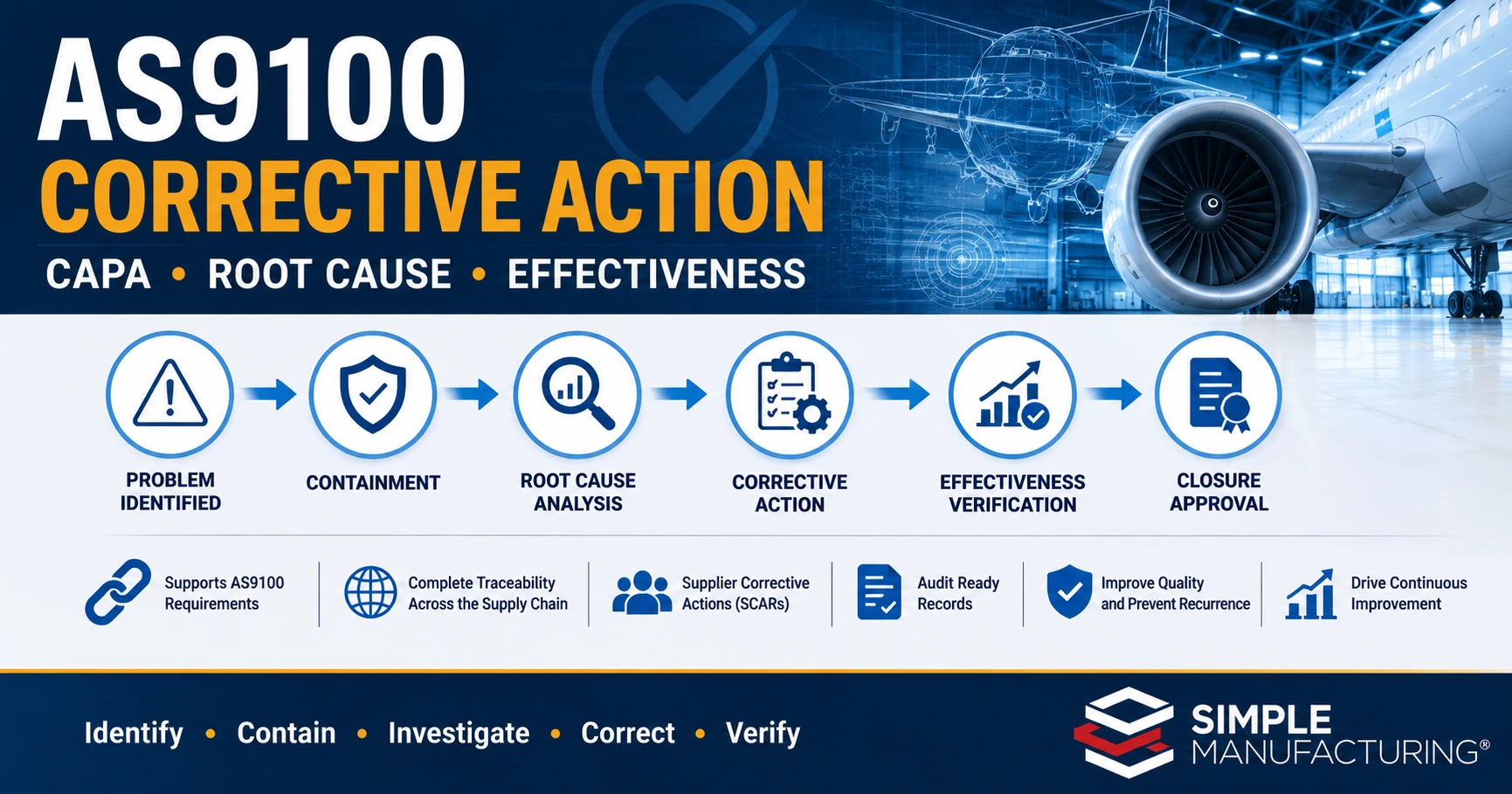
AS9100 corrective action management connects problem identification, containment, root-cause analysis, assigned actions, implementation evidence, effectiveness verification, and controlled closure.
What Is Corrective Action Management?
Corrective action management is the controlled process used to investigate significant or recurring problems and eliminate their underlying causes.
A complete corrective action process may include:
- Problem identification
- Immediate correction
- Containment
- Risk and impact evaluation
- Root-cause analysis
- Corrective-action planning
- Assignment of responsibilities
- Action implementation
- Collection of objective evidence
- Effectiveness verification
- Management approval
- Formal closure
Prevent Recurrence
Identify and eliminate the underlying process, system, supplier, training, equipment, or documentation issue.
Assign Accountability
Define responsible employees, due dates, approval requirements, and escalation paths.
Preserve Evidence
Retain investigation records, analyses, approvals, documents, photographs, and implementation evidence.
Improve Visibility
Provide management with current information about open, overdue, high-risk, and recurring corrective actions.
Support Audits
Demonstrate a consistent process from problem identification through effectiveness verification and closure.
Drive Improvement
Use corrective-action trends to improve manufacturing, suppliers, documents, training, equipment, and quality controls.
Why Corrective Action Is Important in an AS9100 Quality System
Aerospace manufacturing requires reliable processes, controlled product configuration, approved suppliers, extensive traceability, product-safety awareness, and documented quality-system performance.
Corrective action helps manufacturers respond systematically when those controls fail or become ineffective.
Corrective actions may originate from:
- Internal nonconformances
- Customer complaints
- Returned products
- Supplier defects
- Receiving-inspection failures
- In-process inspection failures
- Final-inspection failures
- Internal audit findings
- Certification audit findings
- Customer audit findings
- Delivery-performance problems
- Production disruptions
- Repeated inventory errors
- Equipment or calibration failures
- Process-performance trends
Corrective Action Supports the Quality System
Software does not create AS9100 compliance by itself. It provides the workflows, records, approvals, traceability, notifications, and reporting used to implement and demonstrate the organization’s approved corrective-action process.
Correction vs. Corrective Action
A correction addresses the immediate detected problem. Corrective action addresses the cause of the problem to prevent recurrence.
| Action Type | Purpose | Example |
|---|---|---|
| Correction | Fixes or controls the specific nonconforming condition already identified. | Rework a defective assembly so it meets requirements. |
| Containment | Prevents the known problem from affecting additional products or customers. | Place related inventory and open Work Orders on hold. |
| Corrective Action | Eliminates the underlying cause of the problem. | Revise the process, retrain employees, and add an inspection control after root-cause analysis. |
| Effectiveness Verification | Confirms the implemented action prevented recurrence. | Review production and inspection results after an established monitoring period. |
Correction Alone Does Not Prevent Recurrence
Replacing, repairing, sorting, or reworking affected products may be necessary, but those activities do not eliminate the process failure that created the defect.
Corrective and Preventive Action — CAPA
CAPA is commonly used as a broad term for structured quality-improvement activities involving corrections, corrective actions, risk-based actions, and prevention of future problems.
A CAPA system may manage:
- Quality problems
- Nonconforming products
- Customer complaints
- Supplier performance
- Audit findings
- Process risks
- Training deficiencies
- Documentation problems
- Equipment failures
- Recurring operational errors
The organization should define when a routine correction is sufficient and when a formal corrective action or CAPA investigation is required.
The Corrective Action Process
Identified
Containment
Analysis
Implemented
Verified
Closure
| Process Step | Purpose |
|---|---|
| Problem Definition | Clearly describes what happened, where it occurred, when it occurred, and which requirements were not met. |
| Correction | Addresses the identified nonconforming product or immediate issue. |
| Containment | Prevents additional affected product from being used, processed, or shipped. |
| Impact Review | Determines which products, customers, suppliers, inventory, or processes may be affected. |
| Root-Cause Analysis | Determines why the problem occurred and why the existing controls failed to prevent or detect it. |
| Action Planning | Defines the actions, responsibilities, due dates, and required approvals. |
| Implementation | Completes process, document, training, supplier, equipment, or system changes. |
| Effectiveness Review | Uses objective evidence to confirm recurrence has been prevented. |
| Closure | Confirms all required activities and evidence are complete and approved. |
Define the Problem Clearly
A corrective action begins with a clear and factual description of the problem.
The problem statement may identify:
- The requirement that was not met
- The actual condition observed
- The part number and revision
- The Work Order or Purchase Order
- The affected operation
- The quantity affected
- The lot or serial numbers involved
- The date and location of detection
- The customer or supplier involved
- The business or quality impact
| Weak Problem Statement | Improved Problem Statement |
|---|---|
| Parts were bad. | Five units from Work Order 10452 failed final inspection because hole diameter measured above drawing tolerance. |
| Supplier sent incorrect material. | Supplier receipt 22516 contained material revision B while Purchase Order 7142 required revision C. |
| Employee did not follow instructions. | Operation 30 was performed using an obsolete work instruction because the current revision was not available at the workstation. |
A well-defined problem allows the investigation team to focus on verified facts rather than assumptions about blame or cause.
Immediate Correction
Immediate correction addresses the product, transaction, document, or condition that has already been identified.
Examples include:
- Repairing or reworking affected product
- Replacing incorrect material
- Correcting a document or transaction
- Reinspecting affected inventory
- Returning defective material to a supplier
- Notifying an affected customer
- Correcting an inventory balance
- Removing obsolete instructions from use
The corrective-action record should distinguish the immediate correction from the longer-term action intended to eliminate recurrence.
Containment and Product Protection
Containment prevents potentially affected products from continuing through production or reaching the customer while the issue is investigated.
Containment may include:
- Placing inventory on quality hold
- Stopping a Work Order operation
- Suspending shipment
- Identifying affected lots or serial numbers
- Inspecting related inventory
- Reviewing open Work Orders
- Reviewing previous shipments
- Suspending a supplier or process
- Adding temporary inspection
- Notifying customers or suppliers
Process Failure
Identified
Shipments Reviewed
Notification Applied
Containment Should Match the Potential Scope
Containment should not be limited to the first defective unit when the same material, process, employee, machine, supplier, document, or production method may have affected additional products.
Impact and Extent-of-Condition Analysis
The organization should evaluate whether the identified condition exists elsewhere or affects previously manufactured or delivered product.
The review may include:
- Inventory from the same supplier lot
- Material received on related Purchase Orders
- Other products using the same component
- Other Work Orders using the same routing
- Other employees using the same instruction
- Other machines or fixtures using the same setup
- Previous shipments
- Open customer orders
- Similar processes or departments
- Related customer requirements
Use Product Genealogy and Where-Used Information
Integrated traceability can identify affected materials, Work Orders, finished-product lots, serial numbers, shipments, and customers more quickly than disconnected spreadsheets and paper records.
Root-Cause Analysis
Root-cause analysis determines why the problem occurred and why existing controls failed to prevent or detect it.
Potential cause categories may include:
- Methods and procedures
- Employee training or competency
- Materials and suppliers
- Machines and equipment
- Measurement and inspection
- Environment
- Product design or configuration
- Scheduling and workload
- Documentation and revision control
- Software or system controls
- Management and communication
The person who made an error is not automatically the root cause. The investigation should determine why the system allowed the error to occur or remain undetected.
The Five Whys Method
The Five Whys method repeatedly asks why a condition occurred until the investigation reaches a meaningful process or system cause.
| Question | Example Response |
|---|---|
| Why was the incorrect revision manufactured? | The operator used an obsolete work instruction. |
| Why was the obsolete instruction available? | A printed copy remained at the workstation. |
| Why was the printed copy not removed? | The document-revision process did not include verification of shop floor copies. |
| Why did the process omit that verification? | Document distribution locations were not maintained in the controlled-document record. |
| Why were locations not maintained? | The existing document-control procedure did not assign responsibility for distribution-point verification. |
The resulting corrective action should address controlled distribution and verification rather than only instructing the employee to be more careful.
Fishbone or Cause-and-Effect Analysis
A fishbone analysis organizes possible causes into categories and helps the investigation team evaluate the complete process.
| Cause Category | Example Questions |
|---|---|
| People | Was the employee trained, qualified, adequately supervised, and provided clear information? |
| Methods | Was the process clearly defined, current, practical, and consistently followed? |
| Materials | Was the correct material received, identified, approved, stored, and issued? |
| Machines | Was equipment capable, maintained, calibrated, correctly set up, and available? |
| Measurement | Were inspection methods, sampling, equipment, and acceptance criteria appropriate? |
| Environment | Did temperature, lighting, cleanliness, handling, noise, or workspace contribute? |
The analysis should be supported by objective evidence rather than selecting a convenient cause without verification.
Other Root-Cause Analysis Methods
Different problems may require different investigation methods.
| Method | Typical Use |
|---|---|
| Five Whys | Relatively focused process problems with a logical cause chain. |
| Fishbone Analysis | Problems with several possible contributing categories. |
| Fault-Tree Analysis | Complex failures requiring structured logical analysis. |
| Pareto Analysis | Recurring defects or causes that can be ranked by frequency or impact. |
| Process Mapping | Problems involving handoffs, unclear responsibilities, or missing process steps. |
| Data and Trend Analysis | Problems requiring statistical or historical comparison. |
| Failure Mode and Effects Analysis | Evaluation of potential process or product risks and existing controls. |
Verify the Root Cause
A suspected cause should be tested against available evidence before corrective action is selected.
Verification may include:
- Reproducing the failure
- Reviewing historical records
- Comparing conforming and nonconforming production
- Reviewing employee qualification
- Inspecting equipment and tooling
- Reviewing document revisions
- Analyzing supplier lots
- Reviewing inspection results
- Interviewing involved employees
- Evaluating process data
A Plausible Cause Is Not Necessarily the Root Cause
Corrective actions based on an unverified assumption may add cost and complexity without preventing the problem from recurring.
Developing the Corrective Action Plan
The action plan defines what will change, who will complete each activity, when it is due, and what evidence will demonstrate implementation.
Actions may include:
- Revising a procedure or work instruction
- Changing product design or configuration
- Changing a manufacturing process
- Adding an inspection or error-proofing control
- Repairing or replacing equipment
- Updating tooling or fixtures
- Retraining or reevaluating employees
- Changing supplier controls
- Improving software validation
- Changing approval authority
- Improving product identification or labeling
- Changing inventory or traceability procedures
| Action-Plan Field | Purpose |
|---|---|
| Action Description | Defines the specific change or activity to be completed. |
| Responsible Employee | Assigns accountability. |
| Due Date | Defines the required completion date. |
| Priority | Identifies urgency and business risk. |
| Required Approval | Identifies who must authorize or accept the action. |
| Implementation Evidence | Defines the records required to demonstrate completion. |
| Status | Identifies open, in process, completed, overdue, or cancelled activity. |
Corrective Action Implementation
Completed actions should include objective evidence demonstrating that the planned change was implemented.
Implementation evidence may include:
- Revised procedures or work instructions
- Engineering change records
- Updated routing operations
- Training records
- Equipment repair records
- Calibration records
- Photographs
- Supplier responses
- Inspection records
- Software or database-change records
- Meeting minutes
- Approval records
Completed Does Not Mean Effective
Action implementation confirms that the planned change occurred. Effectiveness verification determines whether that change actually prevented recurrence.
Verification of Effectiveness
Effectiveness verification uses objective evidence to determine whether the corrective action resolved the cause and prevented recurrence.
Effectiveness may be evaluated using:
- Subsequent inspection results
- Production performance
- Supplier quality performance
- Customer complaint history
- Internal audit results
- Inventory accuracy
- Scrap and rework trends
- Employee observations
- Process-capability data
- Repeat-defect monitoring
- Delivery-performance data
| Effectiveness Field | Example |
|---|---|
| Measurement | No repeat defects on the next five production lots. |
| Monitoring Period | 90 days after action implementation. |
| Responsible Reviewer | Quality Manager or process owner. |
| Evidence | Inspection reports, audit results, or trend data. |
| Result | Effective, ineffective, or additional monitoring required. |
A corrective action should not be closed merely because every assigned task is marked complete. The organization should confirm the intended result was achieved.
Corrective Action Closure
Formal closure confirms that required investigation, actions, evidence, and effectiveness verification are complete.
Closure review may verify:
- The problem statement is complete
- Correction and containment were documented
- The affected scope was evaluated
- The root cause was verified
- All actions were completed
- Documents and training were updated
- Implementation evidence is attached
- Effectiveness was verified
- Related records were updated
- Required approvals were completed
Closed corrective actions should remain available for historical review, trend analysis, customer response, and audits.
Corrective Action and Nonconformance Management
Nonconformance management controls individual products, materials, processes, or records that do not meet requirements. Corrective action addresses the underlying causes of significant or recurring problems.
| Nonconformance Record | Corrective Action Record |
|---|---|
| Identifies the specific affected product or condition | Investigates the underlying system or process cause |
| Controls segregation and disposition | Defines actions intended to prevent recurrence |
| Records repair, rework, scrap, return, or acceptance decisions | Records responsibilities, due dates, evidence, and effectiveness |
| May be closed after product disposition | Remains open until effectiveness has been verified |
A nonconformance may create a corrective action when:
- The problem is repeated
- The impact is significant
- A customer requires formal action
- A supplier problem is recurring
- An audit identifies a system failure
- The issue presents product-safety risk
- The existing controls were ineffective
Supplier Corrective Action Requests
A Supplier Corrective Action Request, commonly called a SCAR, formally requires a supplier to investigate and respond to a quality or delivery problem.
A SCAR may be related to:
- Rejected material
- Incorrect part or revision
- Missing certifications
- Late delivery
- Packaging damage
- Incorrect quantities
- Special-process problems
- Recurring supplier defects
- Counterfeit or suspect material concerns
Detected
Contained
Supplier
Actions Reviewed
Supplier Status Updated
The SCAR record may connect:
- Supplier
- Purchase Order
- Receipt
- Part number and revision
- Rejected quantity
- Lot or serial number
- Inspection results
- Supplier response
- Root-cause analysis
- Corrective actions
- Effectiveness verification
- Supplier performance rating
Customer Complaints and Corrective Actions
Customer complaints may create corrective actions when delivered products, documentation, service, or delivery performance fail to meet requirements.
The corrective-action record may link to:
- Customer
- Sales Order
- Shipment
- Invoice
- Part number and revision
- Finished-product lot or serial number
- Work Order
- Materials used
- Inspection history
- Customer communication
- Returned product
- Containment and replacement activity
Use Traceability to Define the Scope
Product genealogy helps identify whether a reported problem is limited to one serialized unit or may affect additional products manufactured from the same materials, process, equipment, or Work Order.
Audit Findings and Corrective Action
Internal, customer, certification, and supplier audits may identify nonconformities requiring formal corrective action.
The audit relationship may include:
- Audit number
- Audit type
- Standard or requirement
- Finding description
- Objective evidence
- Responsible process owner
- Correction
- Root cause
- Corrective action
- Due dates
- Follow-up verification
- Closure approval
Connecting audit findings with corrective actions prevents findings from being managed only through email or static audit reports.
Document Control Integration
Corrective actions frequently require changes to procedures, drawings, specifications, forms, work instructions, inspection plans, and other controlled documents.
Document-control integration can help ensure:
- The affected document is identified
- The proposed change is reviewed
- The revision is approved
- The effective date is controlled
- Obsolete revisions are protected
- Affected employees are identified
- Required retraining is assigned
- The corrective-action record links to the approved revision
Do Not Close Before Required Document Changes Are Effective
A corrective action that depends on a revised instruction or procedure should not be considered implemented until the new revision is approved, released, available, and communicated.
Learn more in our Document Control Software guide.
Employee Training and Competency Integration
Corrective actions may identify a need for new training, retraining, competency evaluation, or changes to job and work-center requirements.
Training actions may include:
- Training on a revised procedure
- Requalification on equipment
- Practical competency evaluation
- Supervisor observation
- Product-specific training
- Inspection-method training
- Corrective-action awareness
- Trainer qualification review
Retraining should not be selected automatically when the true root cause involves an unclear process, obsolete document, inadequate equipment, poor system control, or unrealistic production requirement.
Learn more in our Employee Training Management guide.
Inventory and Traceability Integration
Corrective actions may require identification and control of affected raw materials, components, Work in Process, finished goods, and customer shipments.
Integrated inventory information may include:
- Part number and revision
- Inventory location
- Lot, heat, batch, or serial number
- Supplier and Purchase Order
- Receipt and inspection history
- Current quantity and status
- Work Orders consuming the material
- Finished products containing the material
- Customer shipments
- Quality holds and dispositions
or Process Issue
Identified
Finished Products Reviewed
Identified
Corrective Action Applied
Learn more in our Lot and Serial Number Traceability guide.
Work Order and Production Integration
Production-related corrective actions should connect with the Work Orders, routing operations, employees, machines, materials, and inspections involved.
The relationship may identify:
- Work Order number
- Part number and revision
- Routing operation
- Employees performing the work
- Machine or equipment used
- Materials consumed
- Inspection results
- Completed, rejected, and scrapped quantities
- Work instructions used
- Production date and shift
This allows the investigation team to compare affected and conforming production and evaluate whether the issue is isolated or systemic.
Equipment and Calibration Corrective Actions
Equipment failure, tooling problems, or out-of-calibration measurement equipment may create corrective-action requirements.
The investigation may evaluate:
- Equipment status
- Calibration history
- Maintenance records
- Previous inspection results
- Products inspected or produced
- Employees using the equipment
- Environmental conditions
- Repair and verification records
Evaluate Previously Accepted Product
When measurement equipment is found out of calibration, the organization may need to evaluate products previously accepted using that equipment.
Risk-Based Corrective Action Prioritization
Not every issue carries the same level of risk. Corrective actions can be prioritized according to potential consequences and urgency.
Risk considerations may include:
- Product safety
- Customer impact
- Regulatory or contractual impact
- Quantity affected
- Likelihood of recurrence
- Detection capability
- Delivery impact
- Financial impact
- Supplier or process criticality
- Historical recurrence
| Priority | Example Response |
|---|---|
| Critical | Immediate containment, management escalation, customer review, and frequent status monitoring. |
| High | Formal corrective action with accelerated due dates and management oversight. |
| Moderate | Standard corrective-action workflow and scheduled effectiveness review. |
| Low | Local correction or improvement action when formal corrective action is not justified. |
Automatic Notifications and Escalations
Corrective-action software can notify responsible employees and management of upcoming and overdue activities.
Notifications may be generated for:
- New corrective-action assignments
- Containment due dates
- Root-cause due dates
- Corrective-action due dates
- Upcoming deadlines
- Overdue actions
- Approval requests
- Effectiveness-review dates
- Customer response deadlines
- Supplier response deadlines
Escalation Should Match Risk
High-risk, customer-related, product-safety, and overdue corrective actions may require automatic escalation to process owners, Quality management, or executive leadership.
Management Visibility and Review
Management should have visibility into the status, age, risk, recurrence, and effectiveness of corrective actions.
Management reports may show:
- Open corrective actions
- Overdue corrective actions
- Actions by responsible employee
- Actions by department or process
- Customer corrective actions
- Supplier corrective actions
- Audit-related corrective actions
- Average closure time
- Recurring problem categories
- Ineffective corrective actions
- Effectiveness reviews due
- High-risk open issues
Corrective-action data should support Management Review by showing whether the quality system is solving problems permanently or repeatedly reacting to the same failures.
Corrective Action Management KPIs
| KPI | What It Measures |
|---|---|
| Open Corrective Actions | Current corrective-action workload. |
| Overdue Corrective Actions | Actions remaining open beyond assigned due dates. |
| Average Closure Time | Average time from initiation through approved closure. |
| On-Time Completion Rate | Percentage completed by assigned due dates. |
| Repeat-Occurrence Rate | Frequency of recurring issues after corrective-action closure. |
| Effectiveness Failure Rate | Percentage determined ineffective during follow-up review. |
| Root-Cause Completion Time | Time required to complete and approve cause analysis. |
| Supplier Corrective-Action Response | Supplier completion and responsiveness to SCARs. |
| Customer Complaint Recurrence | Repeated complaints involving the same product, process, or cause. |
| Audit Finding Recurrence | Repeated audit findings involving the same system weakness. |
Common Corrective Action Management Problems
| Problem | Possible Result | Recommended Control |
|---|---|---|
| Problem Statement Is Vague | The investigation focuses on opinions rather than facts. | Document the requirement, actual condition, quantity, location, and evidence. |
| Correction Is Treated as Corrective Action | The defect is repaired but the cause remains. | Separate correction, containment, cause, action, and effectiveness fields. |
| Employee Blame Is Accepted as Root Cause | The system weakness that allowed the error remains unchanged. | Investigate process, training, documentation, equipment, workload, and controls. |
| Root Cause Is Not Verified | Actions may not prevent recurrence. | Require evidence supporting the selected cause. |
| Actions Have No Owner or Due Date | Implementation is delayed or forgotten. | Assign responsibility, due dates, notifications, and escalation. |
| Corrective Action Is Closed After Implementation | The organization never verifies whether the action worked. | Require effectiveness review before closure. |
| Evidence Is Stored in Email | Records are difficult to retrieve during audits. | Attach documents and approvals to the corrective-action record. |
| Related Records Are Not Connected | Traceability, scope, and impact are difficult to evaluate. | Link customers, suppliers, inventory, Work Orders, inspections, and audits. |
| No Trend Analysis | Repeated causes and systemic issues remain hidden. | Use controlled categories and management dashboards. |
Corrective Action Management Best Practices
- Define when formal corrective action is required.
- Use clear and factual problem statements.
- Separate correction, containment, root cause, and corrective action.
- Evaluate the full extent of the condition.
- Use product genealogy and where-used information to identify affected products.
- Select a root-cause method appropriate to the problem.
- Verify the selected cause with objective evidence.
- Address process and system causes rather than relying only on employee retraining.
- Assign specific actions, owners, and due dates.
- Require documented implementation evidence.
- Update controlled documents where necessary.
- Assign and record required retraining.
- Connect supplier issues with supplier performance.
- Use automated notifications and escalation.
- Define effectiveness criteria before closure.
- Verify effectiveness using measurable evidence.
- Require independent or authorized closure approval.
- Preserve complete audit history.
- Analyze corrective-action trends.
- Report significant corrective actions during Management Review.
AS9100 Corrective Action Checklist
- Has the requirement been identified?
- Has the actual nonconforming condition been described?
- Has the affected product or process been identified?
- Has immediate correction been completed?
- Has containment been implemented?
- Has potentially affected inventory and delivered product been evaluated?
- Has the root cause been verified?
- Have contributing causes been considered?
- Are corrective actions appropriate to the verified cause?
- Has responsibility been assigned?
- Have due dates been established?
- Have documents, routings, or processes been updated?
- Has required training been completed?
- Has implementation evidence been attached?
- Have effectiveness criteria been defined?
- Has effectiveness been verified?
- Have required approvals been completed?
- Has the corrective action been formally closed?
How Corrective Action Integrates with Manufacturing ERP
| ERP Process | Corrective Action Relationship |
|---|---|
| Customer Management | Connects complaints, affected orders, shipments, products, and responses. |
| Supplier Management | Connects SCARs, Purchase Orders, receipts, inspections, and supplier performance. |
| Inventory | Identifies and controls affected quantities, locations, lots, serials, and status. |
| Work Orders | Connects production history, employees, machines, materials, and operations. |
| Quality Inspections | Provides requirements, results, defects, equipment, and acceptance history. |
| Nonconformance Management | Connects individual product dispositions with broader systemic investigations. |
| Document Control | Controls procedure, instruction, drawing, and form revisions resulting from actions. |
| Employee Training | Assigns and records required retraining or competency evaluation. |
| Equipment and Calibration | Connects failures, maintenance, calibration, and affected product review. |
| Internal Audits | Connects findings with assigned corrective actions and follow-up verification. |
| Management Review | Provides status, trends, recurring causes, risk, and effectiveness information. |
AS9100 Corrective Action Management with SimpleManufacturing™
SimpleManufacturing™ connects corrective actions with customers, suppliers, Purchase Orders, receipts, inventory, Work Orders, inspections, nonconformances, documents, training, audits, equipment, traceability, and Management Review.
| SimpleManufacturing™ Capability | Business Benefit |
|---|---|
| Controlled Corrective Action Record | Maintains the problem, correction, containment, investigation, actions, evidence, and closure in one record. |
| Root-Cause Analysis | Documents verified causes, contributing causes, analysis methods, and supporting evidence. |
| Assigned Actions | Provides responsible employees, due dates, priorities, status, and approvals. |
| Automated Notifications | Alerts employees and management about assignments, due dates, approvals, and overdue activity. |
| Effectiveness Verification | Records monitoring criteria, review date, evidence, reviewer, and effectiveness result. |
| Nonconformance Integration | Connects individual product defects and dispositions with systemic corrective actions. |
| Supplier Corrective Actions | Connects suppliers, Purchase Orders, receipts, defects, responses, and performance. |
| Customer Complaint Integration | Connects customers, Sales Orders, shipments, serial numbers, Work Orders, and responses. |
| Traceability Integration | Identifies affected inventory, Work Orders, finished products, and customer shipments. |
| Document Control Integration | Connects corrective actions with approved document revisions and change history. |
| Training Integration | Creates and tracks required employee retraining and competency evaluation. |
| Audit Management Integration | Connects internal and external audit findings with corrective-action follow-up. |
| Management Dashboards | Displays open, overdue, high-risk, supplier, customer, and ineffective corrective actions. |
| Electronic Audit History | Records significant changes, users, approvals, dates, and status history. |
One Corrective Action Record Connected with the Complete Manufacturing Process
SimpleManufacturing™ provides centralized visibility from the original quality problem through containment, root-cause analysis, action implementation, effectiveness verification, and approved closure.
Frequently Asked Questions About AS9100 Corrective Action Management
What is corrective action management?
Corrective action management is the controlled process used to identify a problem, contain its effects, determine the underlying cause, implement actions, verify effectiveness, and prevent recurrence.
What is CAPA?
CAPA refers to Corrective and Preventive Action and is commonly used for structured quality-improvement processes involving corrections, root-cause analysis, risk reduction, and prevention of recurring problems.
What is the difference between correction and corrective action?
Correction fixes the immediate detected problem. Corrective action eliminates the underlying cause so the problem does not recur.
What is containment?
Containment prevents potentially affected inventory, Work in Process, finished goods, or shipments from continuing through production or reaching customers while the problem is investigated.
What is root-cause analysis?
Root-cause analysis determines why a problem occurred and why existing controls failed to prevent or detect it.
What are common root-cause analysis methods?
Common methods include Five Whys, fishbone analysis, fault-tree analysis, Pareto analysis, process mapping, data analysis, and Failure Mode and Effects Analysis.
Why is employee error not always the root cause?
The organization should determine why the process, training, documentation, equipment, workload, or system controls allowed the employee error to occur or remain undetected.
What is effectiveness verification?
Effectiveness verification uses objective evidence to determine whether the implemented corrective action eliminated the cause and prevented recurrence.
When should a corrective action be closed?
Closure should occur after required correction, containment, investigation, action implementation, evidence collection, effectiveness verification, and approval are complete.
What is a Supplier Corrective Action Request?
A Supplier Corrective Action Request formally requires a supplier to investigate a quality or delivery problem, identify the cause, implement corrective actions, and provide evidence.
How are customer complaints connected with corrective actions?
Customer complaints can be linked with Sales Orders, shipments, products, serial numbers, Work Orders, materials, inspections, returns, containment, and customer responses.
How are audit findings managed?
Audit findings can create corrective actions containing the requirement, finding, evidence, responsible process owner, cause analysis, actions, due dates, follow-up verification, and closure.
How does document control support corrective action?
Document-control integration ensures that required procedure, drawing, routing, form, or work-instruction revisions are approved, released, distributed, and connected with the corrective-action record.
How does training support corrective action?
Training integration assigns and records retraining, competency evaluation, product-specific instruction, and revised-document training resulting from corrective actions.
How does traceability support corrective action?
Traceability identifies affected supplier receipts, inventory lots, Work Orders, finished-product serial numbers, shipments, and customers.
Which corrective action KPIs should manufacturers track?
Useful KPIs include open actions, overdue actions, average closure time, on-time completion, repeat-occurrence rate, effectiveness failures, supplier response, and audit-finding recurrence.
Does software make a manufacturer AS9100 compliant?
No. Compliance depends on the organization’s approved quality-management system, procedures, implementation, leadership, employee competency, and objective evidence. Software supports those processes.
How does SimpleManufacturing™ manage corrective actions?
SimpleManufacturing™ connects corrective actions with nonconformances, customers, suppliers, inventory, Work Orders, inspections, traceability, documents, training, audits, equipment, effectiveness verification, and Management Review.
Prevent Recurring Quality Problems with Integrated Corrective Action Management
Effective corrective action management requires more than a form and a due date. It requires clear problem definition, immediate containment, verified root-cause analysis, appropriate actions, objective implementation evidence, and meaningful effectiveness verification.
When corrective actions are connected with customers, suppliers, materials, Work Orders, inspections, documents, training, equipment, audits, and traceability, manufacturers gain a complete understanding of the problem and its operational impact.
Identify, Contain, Investigate, Correct, Verify, and Improve
A centralized corrective-action process reduces recurring defects, improves accountability, supports AS9100 audit readiness, strengthens supplier quality, and provides management with meaningful continuous-improvement information.
SimpleManufacturing™ provides integrated corrective action management for aerospace and other manufacturers requiring CAPA, root-cause analysis, nonconformance integration, supplier corrective actions, traceability, document control, training, audit management, effectiveness verification, and complete electronic records.