
Purchase Price Variance, Standard Cost, Last Cost and Actual Cost Explained
Purchase Price Variance and inventory costing methods directly affect inventory valuation, Work Order cost, gross margin, and manufacturing profitability.
Every manufacturing company purchases raw materials, purchased components, outside processing services, tooling, and production supplies. The price paid for those items rarely remains constant.
Supplier price increases, quantity discounts, tariffs, freight charges, expedited deliveries, market shortages, exchange rates, and vendor availability can all change the actual cost of inventory.
Understanding these cost changes is essential because the costing method used by an ERP system determines how material value flows through purchasing, inventory, production, finished goods, and Cost of Goods Sold.
Key Takeaway
Standard Cost, Last Cost, Average Cost, and FIFO Actual Costing can assign different values to the same inventory transaction. The selected method affects financial reporting, product profitability, purchasing analysis, and management decisions.

Why Inventory Costing Methods Matter
Whether a manufacturer uses Standard Cost, Last Cost, Average Cost, or Actual Costing, the selected method directly affects:
- Inventory valuation
- Raw material cost
- Work Order costing
- Finished goods valuation
- Cost of Goods Sold
- Gross profit calculations
- Product and customer profitability
- Purchasing performance analysis
- Financial reporting
- Quoting and pricing decisions
A costing method that does not reflect the real value of inventory can cause product margins to appear higher or lower than they actually are.
This guide explains how Purchase Price Variance works, why many ERP systems rely on Standard Costing, and how FIFO Actual Costing preserves the real purchase cost of inventory throughout the manufacturing process.
What Is Purchase Price Variance?
Purchase Price Variance, commonly abbreviated as PPV, is the difference between the price a company expected to pay for a material and the price it actually paid.
In most Standard Cost systems, the expected amount is the item's predetermined Standard Cost. When the purchase receipt price differs from that Standard Cost, the difference is recorded as a favorable or unfavorable variance.
| Cost Element | Amount per Unit |
|---|---|
| Standard Cost | $12.50 |
| Actual Purchase Receipt Cost | $13.20 |
| Purchase Price Variance | $0.70 unfavorable |
If the company purchases 5,000 units, the total Purchase Price Variance is:
5,000 units × $0.70 variance = $3,500 unfavorable PPV
The variance is unfavorable because the actual purchase price exceeded the Standard Cost.
When the actual purchase price is lower than the Standard Cost, the result is a favorable Purchase Price Variance.
Cost
Price
Variance
PPV Does Not Change the Purchase Price
Purchase Price Variance reports the difference between expected and actual cost. It does not reduce the amount paid to the supplier, explain why the price changed, or automatically improve purchasing performance.
How Purchase Price Variance Is Recorded
Traditional ERP systems normally record inventory at Standard Cost even when the supplier invoice or purchase receipt contains a different price.
The actual receipt value is divided between inventory and a Purchase Price Variance account.
| Transaction Element | Typical Accounting Treatment |
|---|---|
| Inventory Quantity Received | Added to inventory |
| Inventory Value | Recorded using Standard Cost |
| Actual Supplier Cost Difference | Recorded to Purchase Price Variance |
| Supplier Liability | Recorded using the actual purchase amount |
Using the previous example, 5,000 units received at an actual cost of $13.20 would create a total supplier obligation of $66,000.
At a Standard Cost of $12.50, inventory would be valued at $62,500 and the remaining $3,500 would be recorded as unfavorable Purchase Price Variance.
| Accounting Component | Calculated Amount |
|---|---|
| Inventory at Standard Cost | $62,500 |
| Unfavorable Purchase Price Variance | $3,500 |
| Total Supplier Cost | $66,000 |
Why ERP Systems Use PPV
PPV allows an ERP system to keep inventory valued at a stable Standard Cost while separately reporting differences between the expected cost and the actual supplier price.
Favorable and Unfavorable PPV Examples
| Scenario | Standard Cost | Actual Price | Result |
|---|---|---|---|
| Supplier price increase | $12.50 | $13.20 | $0.70 unfavorable |
| Quantity discount | $12.50 | $11.95 | $0.55 favorable |
| Emergency purchase | $12.50 | $15.00 | $2.50 unfavorable |
| Negotiated contract pricing | $12.50 | $12.10 | $0.40 favorable |
A favorable variance is not always proof of strong purchasing performance, and an unfavorable variance is not always evidence of poor purchasing.
The underlying business circumstances must also be considered, including supplier quality, lead time, order quantity, freight, availability, and production requirements.
For additional supplier-management guidance, see the Approved Vendor List guide.
Why Purchase Price Variance Matters
Purchase Price Variance is much more than an accounting calculation. It provides valuable insight into purchasing performance, supplier pricing trends, and the overall stability of manufacturing costs.
While a single variance may not indicate a problem, recurring favorable or unfavorable variances often reveal long-term purchasing trends that deserve management attention.
Management Insight
PPV is best used as an analytical tool rather than a performance metric by itself. Purchasing managers should review the business reasons behind price changes before drawing conclusions.
Common Causes of Unfavorable PPV
- Supplier price increases
- Inflation
- Commodity market fluctuations
- Emergency purchasing
- Low purchase quantities
- Freight surcharges
- Tariffs and import duties
- Material shortages
- Supplier changes
Common Causes of Favorable PPV
- Quantity discounts
- Long-term pricing agreements
- Competitive bidding
- Improved supplier negotiations
- Commodity price reductions
- Strategic purchasing decisions
Pricing
Conditions
Decisions
Variance
Monitoring PPV over time helps purchasing managers identify pricing trends before they significantly affect manufacturing profitability.
Why Material Costs Constantly Change
Manufacturers rarely purchase the same material at exactly the same price twice. Every purchase order is influenced by changing market conditions, supplier pricing, transportation costs, and purchasing strategy.
As a result, inventory costs naturally fluctuate throughout the year.
| Cost Driver | Typical Impact |
|---|---|
| Supplier price increases | Higher inventory cost |
| Commodity markets | Frequent price fluctuations |
| Currency exchange rates | Imported material cost changes |
| Purchase quantity discounts | Reduced unit cost |
| Freight and logistics | Variable landed cost |
| Tariffs and duties | Higher acquisition cost |
| Supplier shortages | Premium purchasing prices |
| Annual contract revisions | Scheduled pricing changes |
Because material costs continually change, relying on one fixed Standard Cost can become increasingly inaccurate unless it is updated regularly.
Static Costs vs. Dynamic Markets
The faster supplier pricing changes, the faster Standard Cost becomes outdated. During periods of inflation or supply chain disruption, the difference between Standard Cost and actual purchase cost can become substantial.
The Four Primary Inventory Costing Methods
Most manufacturing ERP systems determine inventory value using one of four primary costing methods:
| Costing Method | Primary Concept |
|---|---|
| Standard Cost | Predetermined inventory value |
| Last Cost | Most recent purchase price |
| Average Cost | Weighted average inventory value |
| Actual Cost (FIFO) | Original purchase cost of each inventory layer |
Although all four methods value inventory, they often produce different product costs, different inventory values, and different profitability reports.
Receipt
Cost Method
Cost
Sold
Selecting an inventory costing method is one of the most important decisions when implementing a manufacturing ERP system because changing methods later can be time-consuming and may require significant accounting adjustments.
Which Method Is Best?
There is no single costing method that is appropriate for every manufacturer. Standard Cost simplifies accounting, while FIFO Actual Costing provides the most accurate inventory valuation and manufacturing cost information. The best choice depends on your financial reporting requirements, operational goals, and management priorities.
How the Four Methods Differ
Although the same purchase receipts may be used under every costing method, each method determines inventory value differently.
| Method | Inventory Value Based On |
|---|---|
| Standard Cost | Predetermined company-defined cost |
| Last Cost | Most recent purchase receipt |
| Average Cost | Weighted average of inventory on hand |
| Actual Cost (FIFO) | Original cost of the inventory layers consumed |
The following sections explain each costing method in more detail, including where each method performs well and where manufacturers should understand its limitations.
Standard Cost
Standard Cost is one of the most widely used inventory costing methods in manufacturing ERP systems. Instead of valuing inventory using the amount actually paid to suppliers, each item is assigned a predetermined cost established by the company.
This Standard Cost becomes the inventory value used throughout purchasing, manufacturing, inventory transactions, and Cost of Goods Sold until the company decides to revise it.
How Standard Cost Works
Every inventory transaction uses the predefined Standard Cost regardless of the actual purchase price paid to the supplier. Any difference between Standard Cost and the actual purchase price becomes Purchase Price Variance (PPV).
Example
Assume a company establishes a Standard Cost of $12.50 for a purchased component.
| Purchase Receipt | Actual Supplier Cost | Inventory Value | Purchase Price Variance |
|---|---|---|---|
| January | $12.40 | $12.50 | $0.10 Favorable |
| February | $12.65 | $12.50 | $0.15 Unfavorable |
| March | $13.20 | $12.50 | $0.70 Unfavorable |
| April | $11.95 | $12.50 | $0.55 Favorable |
Notice that inventory remains valued at $12.50 even though the supplier's actual price changes every month.
Standard Cost
Valuation
Variance
Advantages of Standard Cost
Standard Cost remains popular because it provides stable inventory values that simplify planning and financial reporting.
| Advantage | Benefit |
|---|---|
| Stable inventory values | Reduces inventory fluctuations |
| Simple product costing | Makes quoting easier |
| Budget comparisons | Supports variance analysis |
| Consistent manufacturing costs | Simplifies operational reporting |
| Performance measurement | Separates purchasing variances from production |
Ideal Use
Standard Cost is particularly useful when management wants stable product costs for budgeting, estimating, operational performance measurement, and financial planning.
Limitations of Standard Cost
Although Standard Cost simplifies accounting, it may not accurately represent the current replacement cost or the actual acquisition cost of inventory.
As supplier prices move away from the established Standard Cost, Purchase Price Variance accounts become larger and inventory values may no longer reflect current purchasing activity.
| Potential Limitation | Business Impact |
|---|---|
| Outdated Standard Cost | Inventory no longer reflects actual acquisition cost |
| Large PPV balances | Requires additional financial analysis |
| Frequent supplier price changes | Standard Cost requires regular maintenance |
| Changing commodity markets | Inventory values may become increasingly inaccurate |
| Actual product profitability | Can differ from reported profitability |
Regular Maintenance Required
Manufacturers using Standard Cost should periodically review and update their standard costs. If standards remain unchanged for long periods while supplier prices continue to fluctuate, Purchase Price Variance can become increasingly difficult to interpret.
Last Cost
The Last Cost method values inventory using the price from the most recent purchase receipt. Every new receipt updates the item's inventory cost to the latest acquisition price.
Unlike Standard Cost, Last Cost automatically follows supplier price changes without generating Purchase Price Variance. However, it also means that all existing inventory immediately reflects the newest purchase price—even inventory purchased months earlier.
How Last Cost Works
Whenever a new purchase receipt is recorded, the inventory cost for that item becomes the cost of the most recent receipt. Future inventory issues and manufacturing transactions use this latest cost.
Example
| Receipt Date | Purchase Cost | Inventory Cost After Receipt |
|---|---|---|
| January | $12.40 | $12.40 |
| February | $12.65 | $12.65 |
| March | $13.20 | $13.20 |
| April | $11.95 | $11.95 |
Notice that each purchase completely replaces the previous inventory cost, regardless of the cost of materials already in stock.
Purchase
Cost
Cost
Advantages of Last Cost
| Advantage | Benefit |
|---|---|
| Simple to maintain | No Standard Cost updates required |
| Reflects current purchases | Responds immediately to supplier price changes |
| No Purchase Price Variance | Reduces accounting complexity |
| Easy to understand | Inventory uses the latest purchase price |
Limitations of Last Cost
Although Last Cost reflects recent purchasing activity, it can produce unrealistic inventory values because every unit in inventory is revalued using the latest purchase price.
| Potential Limitation | Business Impact |
|---|---|
| Historical purchases ignored | Older inventory loses its original cost identity |
| Price volatility | Inventory values change with every receipt |
| No receipt-level traceability | Difficult to analyze historical purchasing costs |
| Large one-time purchases | May distort inventory valuation |
| Limited audit trail | Original acquisition costs are no longer visible |
Historical Costs Are Lost
Because Last Cost continually replaces previous inventory values, it cannot preserve the original acquisition cost of individual purchase receipts. Manufacturers requiring detailed cost genealogy or receipt-level traceability generally choose FIFO Actual Costing instead.
Average Cost
Average Costing, often called Weighted Average Cost, calculates inventory value by averaging the cost of all inventory currently on hand. Each new purchase receipt recalculates the average unit cost using both the existing inventory value and the newly received inventory.
Rather than preserving the original purchase cost of each receipt, Average Cost combines all inventory into one continuously changing average value.
How Average Cost Works
Each purchase receipt updates the weighted average inventory cost. Future inventory issues, Work Orders, and Cost of Goods Sold use this recalculated average rather than the oldest purchase cost or the latest purchase price.
Example
| Receipt | Quantity | Unit Cost | Running Average Cost |
|---|---|---|---|
| January | 1,000 | $4.80 | $4.80 |
| March | 1,000 | $5.20 | $5.00 |
| June | 1,000 | $6.00 | $5.33 |
Although inventory now contains materials purchased at three different prices, every future inventory transaction uses the single weighted average cost of approximately $5.33 per unit.
Inventory
Receipt
Average Cost
Advantages of Average Cost
| Advantage | Benefit |
|---|---|
| Smooths price fluctuations | Reduces sudden inventory value changes |
| Automatically maintained | No manual Standard Cost updates |
| Simple inventory valuation | Easy for accounting and reporting |
| Widely accepted | Supported by many ERP systems |
| Good for commodity materials | Useful when purchase prices change frequently |
Best Application
Average Costing works well when inventory consists of highly interchangeable materials and detailed receipt-level cost traceability is not a business requirement.
Limitations of Average Cost
Because Average Cost combines all purchase receipts into one inventory value, the original acquisition cost of individual receipts is no longer visible.
| Potential Limitation | Business Impact |
|---|---|
| Original receipt costs disappear | No receipt-level audit trail |
| Historical purchases affect future costs | Older prices continue influencing inventory value |
| Rapid market changes | Inventory value may lag current market prices |
| Limited manufacturing traceability | Difficult to determine actual material consumed |
| Reduced product costing accuracy | Manufacturing cost becomes an estimate |
Average Cost Is Still an Estimate
Although Average Cost is generally more representative than Standard Cost or Last Cost, it still estimates the cost assigned to production. It cannot identify the actual purchase receipts consumed by a Work Order.
Actual Costing (FIFO)
Actual Costing preserves the true purchase cost of every inventory receipt. Instead of combining inventory into one cost, every purchase creates its own FIFO inventory layer that retains its original quantity, unit cost, receipt date, supplier information, and remaining balance.
When inventory is issued to manufacturing, the oldest available inventory layer is consumed first using the First-In, First-Out (FIFO) inventory method.
How FIFO Actual Costing Works
Each purchase receipt creates an independent inventory layer. As inventory is consumed, the system removes material from the oldest available layers while preserving the original cost of every purchase receipt.
Example
| Receipt Date | FIFO Layer | Quantity | Unit Cost |
|---|---|---|---|
| January | Layer 1 | 1,000 | $4.80 |
| March | Layer 2 | 1,000 | $5.35 |
| June | Layer 3 | 1,000 | $6.20 |
If production requires 1,500 units, FIFO consumes all 1,000 units from Layer 1 and 500 units from Layer 2. Layer 3 remains untouched until the earlier inventory has been fully consumed.
Receipt
Inventory Layer
Material Issue
Goods
Advantages of Actual Costing
| Advantage | Benefit |
|---|---|
| Actual inventory valuation | Reflects true purchase costs |
| Receipt-level traceability | Maintains complete inventory history |
| Accurate Work Order costing | Production receives actual material cost |
| True Cost of Goods Sold | Improves profitability reporting |
| No Purchase Price Variance required | Eliminates Standard Cost comparisons |
| Supports lot and supplier traceability | Improves quality and audit records |
| Automatic cost management | No Standard Cost maintenance |
Most Accurate Inventory Valuation
FIFO Actual Costing maintains the original acquisition cost of every purchase receipt, allowing inventory, Work Orders, finished goods, and Cost of Goods Sold to reflect the actual costs incurred by the business.
Considerations for FIFO Actual Costing
Although modern ERP systems automate FIFO processing, Actual Costing requires detailed inventory transaction records and consistent inventory control procedures.
| Requirement | Reason |
|---|---|
| FIFO inventory layers | Preserve individual purchase costs |
| Accurate receiving transactions | Create correct inventory layers |
| Reliable inventory control | Maintain quantity and cost integrity |
| Complete transaction history | Support traceability and audits |
| Modern ERP software | Automatically manages FIFO allocation |
FIFO Is No Longer Difficult
Historically, many ERP systems avoided Actual Costing because maintaining FIFO layers required significant computing resources. Modern manufacturing ERP systems such as SimpleManufacturing™ automatically manage FIFO inventory, allowing manufacturers to benefit from accurate inventory valuation without increasing the workload for purchasing, production, or accounting.
Comparing the Four Inventory Costing Methods
Although Standard Cost, Last Cost, Average Cost, and Actual Cost (FIFO) all assign a value to inventory, they do so using very different approaches. Those differences affect purchasing, manufacturing, financial reporting, inventory valuation, and profitability.
The following comparison summarizes how each costing method performs across the areas that matter most to manufacturers.
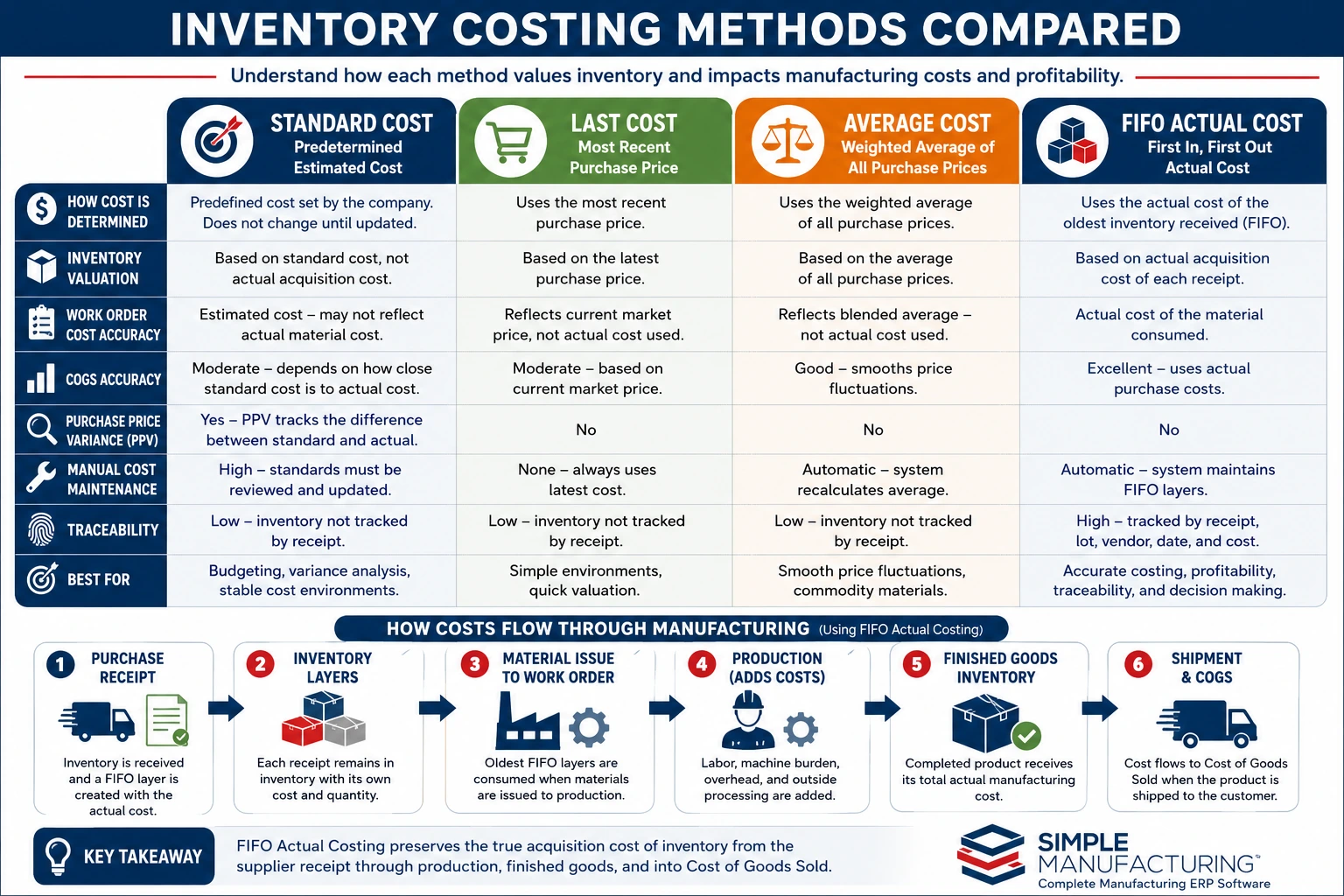
This comparison shows how Standard Cost, Last Cost, Average Cost, and FIFO Actual Cost affect inventory valuation, Work Order costing, Cost of Goods Sold, maintenance requirements, and inventory traceability.
| Feature | Standard Cost | Last Cost | Average Cost | Actual Cost (FIFO) |
|---|---|---|---|---|
| Reflects Actual Purchase Cost | ✖ | Partial | Partial | ✔ |
| Inventory Valuation Accuracy | Moderate | Moderate | Good | Excellent |
| Work Order Cost Accuracy | Estimated | Current Price | Averaged | Actual Cost |
| Cost of Goods Sold Accuracy | Moderate | Moderate | Good | Excellent |
| Purchase Price Variance Required | Yes | No | No | No |
| Manual Cost Maintenance | High | None | Automatic | Automatic |
| Receipt-Level Traceability | No | No | No | ✔ |
| Profitability Accuracy | Moderate | Moderate | Good | Excellent |
Summary
Manufacturers that require accurate inventory valuation, precise Work Order costing, reliable Cost of Goods Sold, and meaningful profitability reporting generally benefit most from FIFO Actual Costing.
Why Do So Many Manufacturers Still Use Standard Costing?
If FIFO Actual Costing provides the most accurate manufacturing costs, why do so many manufacturers continue using Standard Cost?
The answer is largely historical.
For decades, ERP systems had limited computing power and database performance. Maintaining individual inventory layers for every purchase receipt required significantly more processing than assigning a single Standard Cost to each inventory item.
Standard Costing simplified inventory accounting, budgeting, and financial reporting while reducing the amount of data that older ERP systems needed to process.
Historical Perspective
Standard Cost became the industry standard because it was practical for the technology available at the time—not necessarily because it produced the most accurate manufacturing costs.
Why Companies Continue Using Standard Cost
- Legacy ERP software requires it.
- Accounting procedures are already built around PPV.
- Budgets use predetermined material costs.
- Financial statements remain relatively stable.
- Management is familiar with variance reporting.
- Changing costing methods may require accounting policy changes.
These are valid operational reasons, but they should be balanced against the need for accurate inventory valuation and profitability reporting.
Purchase Price Variance Does Not Reduce Purchasing Costs
One of the most common misconceptions is that monitoring Purchase Price Variance reduces purchasing costs.
It does not.
PPV simply reports that a difference exists between Standard Cost and the actual purchase price. It does not explain why that difference occurred or whether the purchasing decision was appropriate.
Think of PPV as a Dashboard Indicator
Purchase Price Variance identifies that costs changed. Purchasing managers still need to determine whether the change resulted from supplier pricing, market conditions, order quantities, freight costs, quality requirements, or production demands.
Large PPVs May Result From Legitimate Business Decisions
- Buying smaller quantities to reduce inventory investment.
- Purchasing from alternate approved suppliers.
- Emergency purchases to prevent production downtime.
- Commodity market fluctuations.
- Supplier price increases.
- Expedited freight or premium shipping.
- Changes in exchange rates or tariffs.
Experienced purchasing professionals evaluate supplier performance, quality, delivery, lead time, purchase history, inventory levels, and total acquisition cost—not simply Purchase Price Variance reports.
Better Purchasing Decisions Require Better Information
Modern ERP systems should provide complete purchasing history, supplier performance, inventory availability, and actual receipt costs so buyers can make informed decisions rather than relying solely on PPV reports.
From Standard Cost to Actual Cost
As manufacturing software has evolved, many of the technical limitations that once justified Standard Costing have disappeared.
Modern ERP systems can automatically track every purchase receipt, maintain FIFO inventory layers, calculate actual Work Order costs, value finished goods accurately, and report true Cost of Goods Sold without increasing the workload for accounting or production personnel.
This is the approach used throughout SimpleManufacturing™, where every purchase receipt contributes to accurate inventory valuation and every Work Order reflects the actual material costs consumed during production.
Why SimpleManufacturing™ Uses FIFO Actual Costing
SimpleManufacturing™ was designed around one fundamental principle:
Manufacturers should know exactly what every product actually costs to build.
Rather than estimating inventory costs using Standard Cost, Last Cost, or Average Cost, SimpleManufacturing™ records the actual cost of every inventory receipt and preserves that information throughout the manufacturing process.
Each purchase receipt creates its own FIFO inventory layer containing the quantity received, unit cost, supplier information, receipt date, and remaining quantity available for production.
When materials are issued to a Work Order, the system automatically consumes inventory from the oldest available FIFO layers, ensuring the Work Order reflects the actual material costs incurred by the business.
Receipt
Inventory
Order
Goods
Goods Sold
One Continuous Cost Flow
The original purchase cost follows the material throughout manufacturing—from the purchase receipt, through inventory, into the Work Order, into Finished Goods, and finally into Cost of Goods Sold when the product ships.
What Information Is Stored in Every FIFO Inventory Layer?
Each purchase receipt becomes a permanent inventory layer that preserves the information required for accurate inventory valuation, traceability, and costing.
| Information Stored | Purpose |
|---|---|
| Purchase Order | Links inventory to the purchasing transaction |
| Vendor | Supplier traceability |
| Receipt Date | Determines FIFO consumption order |
| Quantity Received | Inventory quantity tracking |
| Remaining Quantity | Available inventory in the FIFO layer |
| Actual Unit Cost | True acquisition cost |
| Lot or Serial Information | Quality and traceability |
| Outside Processing Cost | Complete material valuation |
Unlike Standard Cost systems, this information remains associated with the inventory until the layer has been completely consumed.
Real Manufacturing Example
Suppose a manufacturer purchases aluminum throughout the year.
| Receipt Date | Quantity | Unit Cost | FIFO Layer |
|---|---|---|---|
| January | 1,000 lbs | $4.80 | Layer 1 |
| March | 1,000 lbs | $5.35 | Layer 2 |
| June | 1,000 lbs | $6.20 | Layer 3 |
Each purchase receipt remains an independent FIFO inventory layer with its own quantity and acquisition cost.
Now assume a Work Order requires 1,500 pounds of aluminum.
1,000 @ $4.80
500 @ $5.35
Cost
The Work Order consumes all of Layer 1 and only the quantity needed from Layer 2. Layer 3 remains untouched until the earlier inventory has been exhausted.
Why This Matters
The material cost assigned to the Work Order reflects the actual prices paid for the inventory consumed—not an estimate, an average, or the latest purchase price.
How Each Costing Method Produces Different Results
Even though exactly the same material is consumed, each costing method assigns a different value to the Work Order.
| Costing Method | Material Cost Used |
|---|---|
| Standard Cost | Predetermined Standard Cost |
| Last Cost | Latest purchase price ($6.20) |
| Average Cost | Weighted average inventory value |
| FIFO Actual Cost | Layer 1 + Layer 2 actual purchase costs |
Although the production quantity is identical, the reported manufacturing cost varies depending on the inventory costing method used.
One Product — Four Different Costs
Different costing methods can produce different inventory values, different Work Order costs, different Finished Goods values, and different Cost of Goods Sold—even when the same materials are consumed.
Why Actual Cost Produces Better Profitability Reporting
Manufacturing profitability depends on accurately calculating the total cost of producing every finished product. If inventory costs are estimated, profitability is estimated as well.
FIFO Actual Costing provides a more accurate foundation for financial and operational reporting because it uses the actual purchase costs incurred by the business.
| Business Benefit | Result |
|---|---|
| Actual Work Order Costing | True manufacturing costs |
| Finished Goods Valuation | Accurate inventory value |
| Cost of Goods Sold | Actual material costs shipped |
| Gross Margin Reporting | More reliable profitability analysis |
| Pricing Decisions | Based on actual manufacturing costs |
| Management Reporting | Better operational decision making |
Accurate Costs Lead to Better Decisions
When inventory, Work Orders, Finished Goods, and Cost of Goods Sold all use actual material costs, manufacturers gain a clearer understanding of product profitability, customer profitability, and overall business performance.
To learn more about how manufacturing costs continue through production, read our Actual Work Order Costing guide or explore our detailed explanation of FIFO Inventory Costing.
How Costs Flow Through Manufacturing
Manufacturing costs do not begin with a Work Order—they begin the moment inventory is received from a supplier. As materials move through the manufacturing process, their costs move with them until the finished product is shipped to the customer.
SimpleManufacturing™ maintains this continuous flow using FIFO inventory layers, ensuring every inventory transaction preserves the actual acquisition cost of the material consumed.
Order
Receipt
Inventory
Layers
Issue to
Work Order
Overhead
Applied
Goods
Inventory
Shipment &
COGS
Throughout this process, the original purchase cost is never replaced by an estimate. Instead, each manufacturing transaction builds upon the actual material cost already recorded in inventory.
| Manufacturing Stage | What Happens to the Cost? |
|---|---|
| Purchase Order Receipt | Creates a new FIFO inventory layer using the actual supplier cost. |
| Inventory Storage | The material retains its original acquisition cost while it remains in inventory. |
| Material Issue | The oldest FIFO inventory layers are consumed by the Work Order. |
| Production | Labor, machine burden, outside processing, and overhead are added to the Work Order. |
| Finished Goods Receipt | The completed product receives its actual manufacturing cost. |
| Customer Shipment | The Finished Goods cost becomes Cost of Goods Sold (COGS). |
The Complete Manufacturing Cost Chain
Every stage builds upon the previous one. Accurate purchasing creates accurate inventory. Accurate inventory creates accurate Work Order costs. Accurate Work Orders create accurate Finished Goods values. Accurate Finished Goods create accurate Cost of Goods Sold and reliable profitability reporting.
One Continuous Cost Record
Rather than recalculating inventory costs at every step, SimpleManufacturing™ carries the original FIFO material cost forward while adding labor, machine burden, outside processing, and overhead. The result is complete cost traceability from the original supplier receipt through the shipped finished product.
To learn more about each stage of the manufacturing costing process, explore these related guides:
FIFO Inventory Costing
Learn how FIFO inventory layers preserve actual purchase costs and provide accurate inventory valuation throughout manufacturing.
Actual Work Order Costing
See how material, labor, machine burden, outside processing, and overhead combine to determine the actual manufacturing cost of every finished product.
Best Practices for Selecting an Inventory Costing Method
There is no single inventory costing method that is appropriate for every manufacturer. The best choice depends on your company's reporting requirements, production environment, accounting practices, and the level of cost accuracy needed for decision making.
As ERP technology has evolved, many manufacturers have moved away from costing methods that estimate inventory values toward systems that capture and preserve actual costs throughout the manufacturing process.
| If Your Goal Is... | Recommended Costing Method |
|---|---|
| Stable budgeting and financial planning | Standard Cost |
| Simple inventory maintenance | Last Cost |
| Smooth material price fluctuations | Average Cost |
| Accurate inventory valuation | FIFO Actual Cost |
| True Work Order costing | FIFO Actual Cost |
| Reliable profitability reporting | FIFO Actual Cost |
| Complete inventory traceability | FIFO Actual Cost |
Our Recommendation
For manufacturers that want accurate inventory valuation, meaningful profitability reporting, and complete cost traceability, FIFO Actual Costing provides the most complete picture of the true cost of manufacturing.
Frequently Asked Questions
What is Purchase Price Variance (PPV)?
Purchase Price Variance is the difference between the Standard Cost assigned to an inventory item and the actual purchase price paid to the supplier. PPV exists primarily in Standard Cost inventory systems.
Does FIFO Actual Costing use Purchase Price Variance?
No. FIFO Actual Costing records inventory using the actual purchase cost of each receipt, eliminating the need to compare purchases against a predetermined Standard Cost.
Why do many ERP systems still use Standard Cost?
Standard Cost became popular when computing resources were limited and maintaining individual inventory cost layers was difficult. Modern ERP systems can efficiently manage FIFO inventory layers and Actual Costing automatically.
Which inventory costing method is the most accurate?
FIFO Actual Costing generally provides the most accurate inventory valuation because it preserves the original acquisition cost of every inventory receipt and assigns actual material costs to manufacturing.
Can Average Cost replace FIFO?
Average Cost simplifies inventory valuation by blending purchase prices into a single cost. While effective for many businesses, it does not preserve receipt-level costs or provide the same level of manufacturing cost traceability as FIFO.
How does inventory costing affect profitability?
Inventory costs become part of Work Orders, Finished Goods, and ultimately Cost of Goods Sold. More accurate inventory costing results in more reliable gross margin and profitability reporting.
Conclusion
Understanding Purchase Price Variance and the different inventory costing methods is essential for making informed manufacturing and financial decisions. Whether your organization uses Standard Cost, Last Cost, Average Cost, or FIFO Actual Costing, the chosen method influences inventory valuation, Work Order costs, Finished Goods valuation, Cost of Goods Sold, and overall profitability.
Modern manufacturing ERP systems make it possible to move beyond estimated costs by preserving the actual acquisition cost of every inventory receipt throughout the entire manufacturing lifecycle.
Better inventory costing leads to better manufacturing decisions, more accurate financial reporting, and a clearer understanding of product profitability.
If your organization is evaluating manufacturing ERP software or considering a transition to FIFO Actual Costing, SimpleManufacturing™ provides a fully integrated solution designed specifically for manufacturers.