
Quality Clauses in Customer Purchase Orders: Manufacturing Requirements and Contract Review
Quality clauses in customer Purchase Orders are contractual requirements that define how a manufacturer must produce, inspect, document, trace, package, certify, and deliver a product or service.
These clauses are issued by the customer and become part of the manufacturer’s contractual obligations when the order is accepted. They may apply to the entire Purchase Order, a specific line item, one delivery schedule, a particular product revision, or a specialized manufacturing process.
Customer Purchase Order quality clauses are different from the quality requirements a manufacturer places on its own suppliers. Customer clauses flow into the manufacturer through the customer order, while supplier quality clauses flow outward through purchasing and subcontracting.
Customer quality clauses must be identified, reviewed, accepted, communicated, completed, and verified before the affected product is shipped.
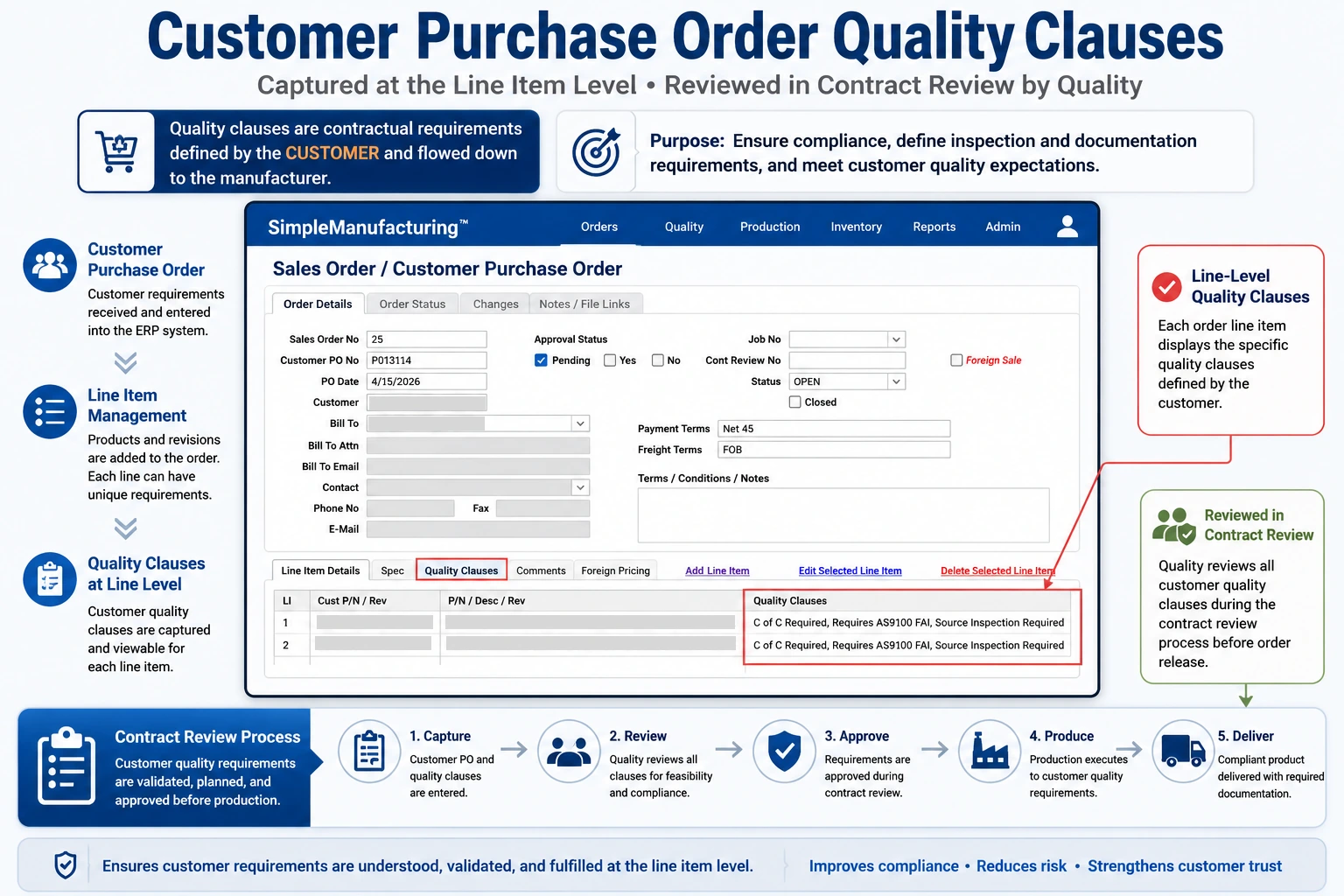
Customer Purchase Order quality clauses define the inspection, documentation, traceability, compliance, and delivery evidence required before the customer can accept a product.
What Are Quality Clauses in Customer Purchase Orders?
A customer Purchase Order quality clause is a requirement imposed by the customer as a condition of accepting the order, product, service, or shipment.
Quality clauses may define:
- Required inspections and tests
- Material and process certifications
- Lot, heat, batch, and serial-number traceability
- Certificate of Conformance requirements
- First Article Inspection requirements
- Customer or source inspection
- Approved supplier or processor restrictions
- Special-process controls
- Packaging and preservation requirements
- Record-retention requirements
- Notification and approval requirements
- Regulatory and industry-standard requirements
When the manufacturer accepts the customer Purchase Order, applicable quality clauses normally become binding contract requirements.
Quality Clauses Are More Than Notes
A quality clause may affect purchasing, production, inspection, documentation, shipping, supplier selection, record retention, and customer acceptance. It should therefore be managed as structured contractual data rather than informal order text.
Customer Quality Clauses vs. Supplier Quality Clauses
Manufacturers frequently use the term “quality clause” for two different types of requirements.
| Clause Type | Issued By | Applied To | Purpose |
|---|---|---|---|
| Customer Purchase Order Quality Clause | The customer | The manufacturer receiving the customer order | Defines the customer’s contractual manufacturing, inspection, documentation, traceability, and delivery requirements. |
| Supplier Purchase Order Quality Clause | The manufacturer | A supplier or outside processor | Flows applicable requirements to organizations providing materials, components, or processing services. |
Quality Clauses
Review and Production
Flowdown
Outside Processor
Do Not Confuse Incoming and Outgoing Requirements
The manufacturer must first understand the customer’s requirements and then determine which of those requirements must be flowed down to suppliers, subcontractors, inspection laboratories, or outside processors.
Why Customer Purchase Order Quality Clauses Matter
A product can meet its drawing dimensions and still be rejected when required documentation, traceability, inspections, approvals, or certifications are missing.
Contract Compliance
Quality clauses define obligations that must be satisfied after the manufacturer accepts the order.
Product Acceptance
The customer may withhold acceptance or payment when required records and certifications are incomplete.
Traceability
Clause requirements may determine which material lots, suppliers, processes, employees, and serial numbers must be documented.
Production Planning
Inspections, special processes, documentation, and source approvals can affect routing and lead time.
Supplier Flowdown
Applicable requirements must reach the suppliers and processors performing affected work.
Audit Readiness
Structured clause records provide evidence that contractual requirements were reviewed and fulfilled.
Common Customer Purchase Order Quality-Clause Requirements
| Requirement Category | Examples |
|---|---|
| Inspection | Receiving inspection, first-piece inspection, in-process inspection, final inspection, source inspection |
| Testing | Functional testing, electrical testing, pressure testing, destructive testing, nondestructive testing |
| Certifications | Certificate of Conformance, material certification, process certification, test report |
| Traceability | Lot, batch, heat, date code, serial number, supplier, manufacturer, Work Order, shipment |
| First Article | AS9102 First Article Inspection, delta FAI, customer-specific first article format |
| Special Processes | Plating, welding, heat treatment, painting, nondestructive testing, passivation |
| Approved Sources | Customer-approved manufacturers, suppliers, laboratories, or special-process providers |
| Records | Retention period, customer access, electronic format, retrieval requirements |
| Packaging | Preservation, labeling, ESD protection, moisture protection, special containers |
| Notification | Approval before substitution, process change, facility change, nonconformance, or shipment |
| Regulatory | Export controls, counterfeit-part prevention, RoHS, REACH, conflict minerals, industry standards |
| Shipping Documentation | Packing slip, Certificate of Conformance, inspection report, test data, serialization list |
Examples of Customer Quality Clauses
The exact language varies by customer, but clauses may require actions such as:
- Provide a Certificate of Conformance with every shipment.
- Maintain complete lot traceability from raw material through final shipment.
- Use only customer-approved suppliers and special-process providers.
- Submit First Article Inspection results before production approval.
- Notify the customer before making changes to product, process, supplier, tooling, or manufacturing location.
- Retain quality records for a defined number of years.
- Allow customer, regulatory, or government representatives access to applicable facilities and records.
- Prevent the use of counterfeit or suspect counterfeit electronic components.
- Supply material certifications and special-process certificates with each shipment.
- Obtain customer approval before accepting a nonconforming condition.
- Identify serialized units on the packing slip and Certificate of Conformance.
- Apply customer-specific labeling, packaging, preservation, or shelf-life requirements.
Actual clauses should be reviewed according to their exact wording. Similar clause titles used by different customers may create different contractual obligations.
Order-Level and Line-Item-Level Quality Clauses
Quality requirements may apply at several levels of a customer order.
| Application Level | Example |
|---|---|
| Customer Level | A standing customer requirement applies to all orders. |
| Purchase Order Level | A record-retention or right-of-access requirement applies to the complete customer PO. |
| Order Line Level | A First Article requirement applies only to one product or revision. |
| Delivery-Schedule Level | A source inspection applies only to a particular scheduled shipment. |
| Product Level | Serialization or material certification is always required for the selected product. |
| Operation Level | A special-process certification applies to heat treatment or plating. |
Capturing clauses at the line-item level prevents requirements for one product from being incorrectly applied to every product—or overlooked because they were stored only as general order notes.
Reviewing Quality Clauses During Contract Review
Customer Purchase Order quality clauses should be reviewed before the manufacturer accepts the order or releases production.
Contract Review should determine:
- Which clauses apply
- Which order lines are affected
- Whether the requirement is clear
- Whether the company can comply
- Whether additional cost is involved
- Whether additional lead time is required
- Whether special equipment or inspection is needed
- Whether customer approval is required
- Whether suppliers or processors must receive flowdown
- Which records must be retained
- Which documents must accompany shipment
- Who is responsible for completing each requirement
Received
Identified
Contract Review
Cost, and Planning
and Released
Learn more in our Manufacturing Contract Review guide.
Cross-Functional Quality-Clause Review
| Department | Review Responsibility |
|---|---|
| Sales or Customer Service | Confirms the customer order, commercial terms, delivery requirements, and customer communication. |
| Quality | Reviews inspection, certification, traceability, record-retention, and compliance requirements. |
| Engineering | Reviews technical specifications, product revision, process requirements, and change restrictions. |
| Purchasing | Determines which requirements must be flowed down to suppliers and outside processors. |
| Production | Evaluates routing, equipment, tooling, training, and production capability. |
| Inventory | Evaluates material identification, segregation, lot control, shelf life, and traceability. |
| Shipping | Reviews packaging, labels, documentation, serialization, and delivery requirements. |
| Finance | Evaluates added cost, pricing, billing milestones, penalties, and commercial risk. |
Clarifying Ambiguous or Conflicting Clauses
A clause should be clarified when its meaning, scope, applicability, or required evidence is uncertain.
Clarification may be needed when:
- The Purchase Order references an unavailable customer document.
- The clause revision is not identified.
- The clause conflicts with the drawing or specification.
- Two customer documents impose different requirements.
- The requirement cannot be met by the requested delivery date.
- The customer requires a certification that does not apply to the product.
- The requested inspection method is unavailable.
- The required supplier or process source is not approved or available.
- The retention period is not specified.
- The clause requires customer approval but does not identify the approval process.
Do Not Resolve Ambiguity Through Assumption
Unclear contractual requirements should be documented and clarified with the customer before order acceptance or production release.
Cost and Schedule Impact of Quality Clauses
Quality clauses can create significant cost and lead-time requirements.
| Clause Requirement | Possible Cost or Schedule Impact |
|---|---|
| First Article Inspection | Inspection labor, report preparation, equipment time, customer review, and production hold |
| Source Inspection | Customer scheduling, facility access, product hold, and additional coordination |
| Special Certification | Supplier documentation, laboratory testing, administrative review, and record retention |
| Serialization | Labeling, database records, unit-level inspection, and shipment documentation |
| Approved Processor | Longer lead time, minimum charges, transportation, or limited capacity |
| Enhanced Inspection | Additional inspector time, equipment, sampling, or 100-percent inspection |
| Long-Term Record Retention | Document storage, backup, retrieval, and data-management cost |
| Customer-Specific Packaging | Special materials, labels, containers, handling, and validation |
Review Before Pricing and Acceptance
Clause-related costs should be identified during quotation and Contract Review instead of discovered after production begins.
Flowing Customer Requirements to Suppliers
Manufacturers are often responsible for flowing applicable customer requirements to suppliers and outside processors.
Flowdown may be required for:
- Approved-source restrictions
- Material certifications
- Special-process certifications
- Lot and heat traceability
- Counterfeit-part prevention
- Record retention
- Right of access
- Change notification
- Customer approval requirements
- Inspection and testing
- Packaging and preservation
- Regulatory requirements
Requirement
Review
Order Clause
Performance
Receiving Verification
The manufacturer remains responsible for the customer requirement even when part of the work is performed by a supplier or outside processor.
Approved Suppliers and Special-Process Sources
Some customers restrict materials or processes to approved manufacturers, suppliers, laboratories, or processing facilities.
The ERP system should identify:
- Approved manufacturer
- Approved manufacturer part number
- Approved supplier
- Approved outside processor
- Applicable customer
- Applicable product or program
- Approval status
- Approval expiration
- Required certifications
- Process specification
- Customer-source approval
Learn more in our Approved Vendor List guide.
Flowing Quality Clauses into Work Orders and Production
Once the order is accepted, applicable clauses should be translated into production requirements.
Requirements may flow into:
- Work Order header
- Manufacturing traveler
- Routing operations
- Material requirements
- Employee instructions
- Inspection plans
- Outside-processing Purchase Orders
- Lot and serial controls
- Document packages
- Final inspection
- Shipping release checklist
| Customer Clause | Operational Flowdown |
|---|---|
| First Article Inspection Required | Add FAI operation, required forms, product hold, and approval status. |
| Serialized Product | Require serial-number assignment, operation history, inspection, and shipment reporting. |
| Material Certification Required | Require supplier certification at receipt and link it with the Work Order and shipment. |
| Special Process Required | Add routing operation, approved processor, specification, Purchase Order, and certificate requirement. |
| Customer Source Inspection | Create inspection hold, notification requirement, customer approval, and release record. |
| Certificate of Conformance | Add final-document requirement before shipment release. |
Learn more in our Manufacturing Work Order Management guide.
Inspection and Testing Requirements
Customer clauses may determine which inspections are required and when they must occur.
| Inspection Type | Purpose |
|---|---|
| Receiving Inspection | Verifies purchased material and supplier documentation before use. |
| First-Piece Inspection | Confirms setup and initial output before production continues. |
| First Article Inspection | Verifies the complete production process can create a conforming product. |
| In-Process Inspection | Checks characteristics during manufacturing. |
| Final Inspection | Verifies finished product before shipment. |
| Source Inspection | Allows customer or authorized representative review before shipment. |
| Functional Testing | Verifies product operation and performance. |
| Laboratory Testing | Verifies material, chemical, mechanical, or environmental characteristics. |
First Article Inspection Requirements
A customer quality clause may require a full or partial First Article Inspection before production is accepted.
The requirement should define or reference:
- Applicable standard or customer format
- Full or partial FAI
- Part number and revision
- Drawing characteristics
- Material and process certifications
- BOM accountability
- Functional test results
- Customer approval requirement
- Production hold requirements
- Conditions requiring a new or delta FAI
Do Not Assume an FAI Is Only Dimensional Inspection
Depending on the customer requirements, an FAI may include material, process, functional-test, drawing, BOM, source, and documentation verification.
Material and Special-Process Certifications
Customer clauses frequently require certificates demonstrating that material and special processes satisfy specified requirements.
Examples include:
- Raw-material certification
- Mill test report
- Chemical composition report
- Mechanical-property report
- Heat-treatment certification
- Plating certification
- Welding certification
- Passivation certification
- Nondestructive-testing report
- Calibration certificate
- Laboratory test report
- Certificate of Conformance
Certificates should be reviewed for:
- Correct part or material
- Correct specification and revision
- Correct lot, heat, batch, or serial number
- Correct quantity
- Approved supplier or processor
- Required test results
- Authorized signature
- Applicable dates
- Complete traceability
Lot, Heat, Batch, and Serial Traceability
Customer clauses may require complete product genealogy from purchased material through customer shipment.
Purchase Order
Heat, or Batch
Routing Operations
Lot or Serial
Customer
Traceability may include:
- Supplier
- Manufacturer
- Purchase Order
- Receipt date
- Material certification
- Lot number
- Heat number
- Batch number
- Date code
- Serial number
- Work Order
- Employees and equipment
- Inspection results
- Outside processors
- Finished-product identification
- Customer shipment
Learn more in our Lot and Serial Number Traceability guide.
Certificate of Conformance Requirements
A Certificate of Conformance confirms that the product or service was completed according to applicable order and specification requirements.
A customer may require the Certificate of Conformance to include:
- Customer name
- Customer Purchase Order
- Purchase Order line
- Part number
- Revision
- Description
- Quantity shipped
- Lot or serial numbers
- Applicable specifications
- Statement of conformity
- Country of origin
- Authorized signature
- Certification date
Use Customer-Specific Formats When Required
Some customers require exact wording, fields, signatures, or document formats. These requirements should be identified during Contract Review and controlled through the shipping-document process.
Customer and Government Source Inspection
Some clauses require the customer, government, or authorized representative to inspect the product before shipment.
The process may require:
- Advance notification
- Product-completion status
- Inspection date coordination
- Required documentation package
- Controlled product hold
- Facility access
- Measurement equipment and records
- Customer acceptance or release
- Shipment authorization
Do Not Ship Before Required Release
When source inspection or customer approval is contractually required, the ERP system should prevent shipment until the approval or waiver is recorded.
Change Notification and Customer Approval
Customer clauses may restrict changes to the product, process, supplier, tooling, software, or manufacturing location.
Approval may be required before changing:
- Part design
- Bill of Materials
- Raw material
- Manufacturer or supplier
- Special-process source
- Manufacturing process
- Tooling
- Inspection method
- Test method
- Manufacturing location
- Software or firmware
- Packaging
The Item Master, Bill of Materials, Engineering Change Order, supplier approval, and customer relationship should identify applicable restrictions.
Customer Approval of Nonconforming Product
Some customer clauses prohibit use-as-is or repair dispositions without written customer authorization.
The approval request may include:
- Customer Purchase Order
- Part number and revision
- Affected quantity
- Lot or serial numbers
- Requirement
- Actual condition
- Technical evaluation
- Proposed disposition
- Risk assessment
- Supporting photographs or data
- Customer approval or rejection
Customer approval should be retained with the nonconformance, Work Order, product, shipment, and Contract Review records.
Quality Record-Retention Requirements
Customer clauses may specify how long quality and production records must be retained.
Records may include:
- Contract Review
- Purchase Orders
- Supplier certifications
- Receiving inspection
- Material traceability
- Work Orders and travelers
- Employee qualifications
- Inspection results
- Test records
- Calibration records
- First Article Inspection
- Nonconformance records
- Customer approvals
- Certificates of Conformance
- Shipping records
| Retention Attribute | Purpose |
|---|---|
| Record Type | Identifies which records are subject to retention. |
| Retention Period | Defines how long records must be maintained. |
| Retention Start | Defines whether the period begins at creation, shipment, order closure, or another event. |
| Storage Format | Defines paper, electronic, original, or approved digital format. |
| Access Requirement | Defines customer, government, regulatory, or audit access. |
| Disposition | Defines secure destruction or archive after the retention period. |
Packaging, Labeling, and Preservation Requirements
Quality clauses may establish how the product must be protected and identified during storage and shipment.
Requirements may include:
- Customer-specific packaging
- ESD protection
- Moisture-barrier packaging
- Desiccant and humidity indicators
- Protective caps and plugs
- Corrosion prevention
- Clean-room packaging
- Part and revision labels
- Lot or serial-number labels
- Country-of-origin labels
- Expiration or shelf-life labels
- Customer barcodes
- Special handling markings
Verifying Quality Clauses Before Shipment
The final shipping-release process should confirm that all applicable customer quality clauses have been completed.
| Shipment Verification | Example Evidence |
|---|---|
| Product Acceptance | Final inspection or test approval |
| Quantity | Accepted quantity matches the shipment |
| Part and Revision | Shipment matches the customer order |
| Traceability | Required lot, heat, batch, and serial records are complete |
| Material Certification | Required supplier or mill certificate is available |
| Process Certification | Required outside-processing certificate is available |
| First Article | FAI is complete and approved when required |
| Customer Approval | Source inspection, deviation, or waiver is recorded |
| Certificate of Conformance | Correct customer format and content are complete |
| Packaging and Labels | Customer-specific preservation and identification are verified |
Complete
Accepted
Checklist Complete
Certifications Verified
Released
Tracking Quality-Clause Status
Each applicable clause can be assigned a status so users can distinguish between identified requirements and completed requirements.
| Status | Meaning |
|---|---|
| Identified | The clause has been captured from the customer order. |
| Under Review | The requirement is being evaluated during Contract Review. |
| Clarification Required | Customer input or missing documentation is needed. |
| Accepted | The company has confirmed it can meet the requirement. |
| Flowdown Required | The requirement must be placed on a supplier or outside-processing order. |
| Planned | The requirement has been added to the routing, Work Order, inspection plan, or shipping checklist. |
| In Process | Required activity is underway. |
| Evidence Pending | The activity is complete but required documentation has not been received. |
| Complete | The requirement and supporting evidence have been verified. |
| Waived | The customer has provided documented authorization not to perform the requirement. |
Quality-Clause Audit Trail
An electronic audit history should preserve how each requirement was received, reviewed, changed, assigned, and completed.
The history may record:
- Customer Purchase Order
- Clause number and revision
- Clause text or referenced document
- Applicable order line
- Date identified
- Person recording the requirement
- Reviewers and approvals
- Clarification correspondence
- Supplier flowdown
- Work Order or routing relationship
- Inspection or certification evidence
- Completion status
- Shipment relationship
- Changes and previous values
Common Quality-Clause Management Problems
| Problem | Possible Result | Better Control |
|---|---|---|
| Clauses Stored Only as Order Notes | Requirements may not reach Quality, Production, Purchasing, or Shipping. | Store clauses as structured order-line requirements. |
| Clause Revision Not Recorded | The wrong customer requirement may be applied. | Record clause document number and revision. |
| No Applicability Review | Requirements may be over-applied or missed. | Link each clause with the affected order, product, line, or operation. |
| Clauses Reviewed After Order Acceptance | Unexpected cost, lead time, or capability problems are discovered too late. | Include Quality in Contract Review before release. |
| Supplier Flowdown Missing | Purchased material or outside processing fails customer requirements. | Generate applicable supplier clauses from reviewed customer requirements. |
| Clause Not Added to Work Order | Production or inspection personnel do not receive the requirement. | Flow requirements into routing, traveler, inspection, and documentation tasks. |
| Evidence Not Linked | Employees cannot prove the requirement was completed. | Link certificates, reports, approvals, and inspection results. |
| Shipment Released Too Early | Product ships without required customer documentation or approval. | Use a clause-completion shipping hold. |
Customer Quality-Clause Management Best Practices
- Capture every customer Purchase Order clause.
- Record the applicable clause document and revision.
- Distinguish customer clauses from supplier clauses.
- Assign clauses at the correct order, line, delivery, product, or operation level.
- Review clauses during Contract Review.
- Involve Quality, Engineering, Purchasing, Production, and Shipping.
- Clarify ambiguous or conflicting requirements before acceptance.
- Evaluate cost and lead-time impact.
- Identify customer-approval requirements.
- Determine supplier and processor flowdown.
- Use approved suppliers and processors.
- Add requirements to Work Orders and routings.
- Assign required inspections and tests.
- Capture lot, heat, batch, and serial traceability.
- Collect material and process certifications.
- Control First Article and source-inspection requirements.
- Track customer deviations and waivers.
- Define record-retention requirements.
- Verify packaging and labeling requirements.
- Link objective evidence with the clause.
- Prevent shipment until required clauses are complete.
- Maintain an electronic audit history.
- Review recurring customer requirements for reusable templates.
- Train employees responsible for clause review and completion.
Quality-Clause Management KPIs
| KPI | What It Measures |
|---|---|
| Clause Review Completion Rate | Customer orders reviewed for quality clauses before acceptance. |
| Clause Clarification Rate | Percentage requiring customer clarification. |
| Late Requirement Discovery | Clauses first identified after production release. |
| Supplier Flowdown Accuracy | Applicable clauses correctly included on supplier orders. |
| Clause Completion Rate | Requirements completed before the shipment due date. |
| Documentation Error Rate | Shipments delayed or rejected because of missing or incorrect documents. |
| Customer Rejection Rate | Orders rejected for contractual quality-requirement failures. |
| Quality-Clause Cycle Time | Time from order receipt through completed review. |
| Shipping-Hold Rate | Shipments held because required clause evidence is incomplete. |
| Recurring Clause Usage | Common customer requirements suitable for reusable templates. |
Why Quality Clauses Should Be Integrated with Manufacturing ERP
| ERP Process | Quality-Clause Relationship |
|---|---|
| Customer and Contacts | Provides standing customer requirements and communication history. |
| Sales Orders | Captures the customer PO, order lines, revisions, and applicable clauses. |
| Contract Review | Confirms requirement clarity, capability, acceptance, cost, and risk. |
| Item Master | Provides product-specific inspection, traceability, and compliance controls. |
| Bill of Materials | Identifies purchased materials requiring customer flowdown. |
| Purchase Orders | Communicates applicable requirements to suppliers and processors. |
| Receiving | Captures certifications, lots, inspections, and supplier evidence. |
| Work Orders | Communicates production, routing, inspection, and documentation requirements. |
| Quality Management | Controls inspections, nonconformances, customer approvals, and certifications. |
| Document Control | Provides current customer specifications, clause documents, and procedures. |
| Shipping | Verifies clause completion, packaging, labeling, and required documents. |
| Audit Trail | Records review, approvals, changes, evidence, and shipment release. |
Customer Quality-Clause Management with SimpleManufacturing™
SimpleManufacturing™ connects customer Purchase Order quality clauses with order entry, Contract Review, line-item requirements, quality review, purchasing flowdown, Work Orders, inspections, traceability, document control, and shipment release.
| SimpleManufacturing™ Capability | Business Benefit |
|---|---|
| Order-Line Clause Assignment | Connects requirements with the exact product or delivery affected. |
| Contract Review Integration | Routes quality requirements for review before order release. |
| Customer Clause Library | Supports reusable clause definitions and customer-specific requirements. |
| Quality Review Responsibility | Provides ownership, approval, status, and due-date control. |
| Supplier Flowdown | Transfers applicable requirements to supplier and outside-processing Purchase Orders. |
| Work Order Integration | Communicates production, inspection, traceability, and documentation requirements. |
| Document Attachments | Links customer documents, specifications, certificates, reports, and approvals. |
| Lot and Serial Traceability | Connects material receipts, Work Orders, finished products, and shipments. |
| Inspection and Testing | Creates required receiving, in-process, First Article, final, and source-inspection activity. |
| Shipping Release Control | Prevents shipment before required documentation and approvals are complete. |
| Audit History | Records who identified, reviewed, approved, changed, and completed each requirement. |
| Cross-Functional Visibility | Allows Sales, Quality, Purchasing, Production, Inventory, and Shipping to use the same requirements. |
One Requirement Record from Customer Order Through Shipment
SimpleManufacturing™ allows customer quality clauses to remain connected with the order line, product, Work Order, suppliers, inspections, certifications, approvals, traceability records, and final shipment.
Frequently Asked Questions About Customer Purchase Order Quality Clauses
What are quality clauses in customer Purchase Orders?
They are contractual customer requirements defining inspection, documentation, traceability, compliance, certification, packaging, approval, or other obligations that the manufacturer must satisfy.
Are customer quality clauses legally binding?
They may become binding contractual requirements when the manufacturer accepts the customer Purchase Order. Contractual interpretation should be reviewed according to the applicable agreement and legal requirements.
How are customer quality clauses different from supplier quality clauses?
Customer clauses are requirements imposed on the manufacturer by the customer. Supplier clauses are requirements the manufacturer imposes on suppliers and outside processors.
When should quality clauses be reviewed?
They should be reviewed during quotation and Contract Review before order acceptance or production release.
Who should review customer quality clauses?
Review may involve Sales, Quality, Engineering, Purchasing, Production, Inventory, Shipping, and Finance depending on the requirement.
Should clauses be stored at the order or line-item level?
They should be assigned at the most specific applicable level. Line-item control is important when different products or revisions have different requirements.
What happens when a clause is unclear?
The requirement should be documented and clarified with the customer before the order is accepted or production is released.
Can quality clauses affect pricing?
Yes. Additional inspection, documentation, testing, traceability, supplier restrictions, packaging, or approvals may increase cost and lead time.
What is quality-requirement flowdown?
Flowdown is the process of communicating applicable customer requirements to suppliers, subcontractors, laboratories, or outside processors.
What is a Certificate of Conformance?
It is a document confirming that the product or service conforms to applicable Purchase Order, drawing, specification, and contract requirements.
What is source inspection?
Source inspection allows the customer, government, or authorized representative to inspect or release product before shipment.
What is First Article Inspection?
First Article Inspection provides documented verification that the planned production process can produce a product satisfying applicable design requirements.
How are quality clauses communicated to production?
They may be placed on Work Orders, travelers, routing operations, inspection plans, material requirements, employee instructions, and production-document packages.
How are clauses verified before shipment?
A shipping-release checklist can confirm that inspections, traceability, certifications, approvals, packaging, labels, and required customer documents are complete.
Can a customer approve nonconforming product?
A customer may authorize a deviation, use-as-is disposition, or repair when permitted by the contract and applicable requirements. Written approval should be retained.
What records may be required?
Records may include Contract Review, supplier certificates, inspections, Work Orders, material traceability, First Article results, test reports, calibration, nonconformance approvals, and shipping documentation.
How long should quality records be retained?
The retention period depends on customer clauses, contracts, regulatory requirements, industry standards, and company procedures.
Can an ERP system prevent shipment when clauses are incomplete?
Yes. A controlled shipping-release process can block shipment until required clause statuses, documents, approvals, and inspection results are complete.
How does SimpleManufacturing™ manage customer quality clauses?
SimpleManufacturing™ connects customer clauses with Sales Order lines, Contract Review, quality approval, supplier flowdown, Work Orders, inspections, traceability, documentation, and shipment release.
Control Customer Quality Requirements from Order Entry Through Shipment
Customer Purchase Order quality clauses define the evidence, controls, inspections, traceability, certifications, approvals, and documentation required to fulfill the customer contract.
Effective clause management begins during quotation and Contract Review, continues through supplier flowdown and production, and ends only after every applicable requirement has been verified before shipment.
Identify, Review, Flow Down, Complete, and Verify
Structured quality-clause management reduces missed requirements, shipment delays, customer rejections, documentation errors, and compliance risk.
SimpleManufacturing™ connects customer quality clauses with Sales Order lines, Contract Review, purchasing, Work Orders, inspections, traceability, documentation, and shipment release within one integrated manufacturing ERP system.